PE M&A Activity ↑12.4%│ Industrial EBITDA Multiples 7.2×│ B2B Buyer Trust Index ↓31%│ SEO Click-Through Rate ↓44%│ LMM Deal Volume ↑8.1%│ Sales Hire Failure Rate 67%│ Organic Growth Gap 2.3× plan│ PE Dry Powder $2.59T│ PE M&A Activity ↑12.4%│ Industrial EBITDA Multiples 7.2×│ B2B Buyer Trust Index ↓31%│ SEO Click-Through Rate ↓44%│ LMM Deal Volume ↑8.1%│ Sales Hire Failure Rate 67%│ Organic Growth Gap 2.3× plan│ PE Dry Powder $2.59T│
ED MARSH CONSULTING · PRIVATE EQUITY

The Organic Growth Playbook
PE Doesn't Have.

You have proven playbooks for financial improvements, operational efficiency, and bolt-on acquisitions.

The fourth lever, organic revenue growth, is where assumptions replace rigor, timelines slip, and IRR erodes. Ed brings process engineering, empirical measurement, and three decades of industrial sales expertise to the one part of the value-creation bridge most sponsors can't build on their own.

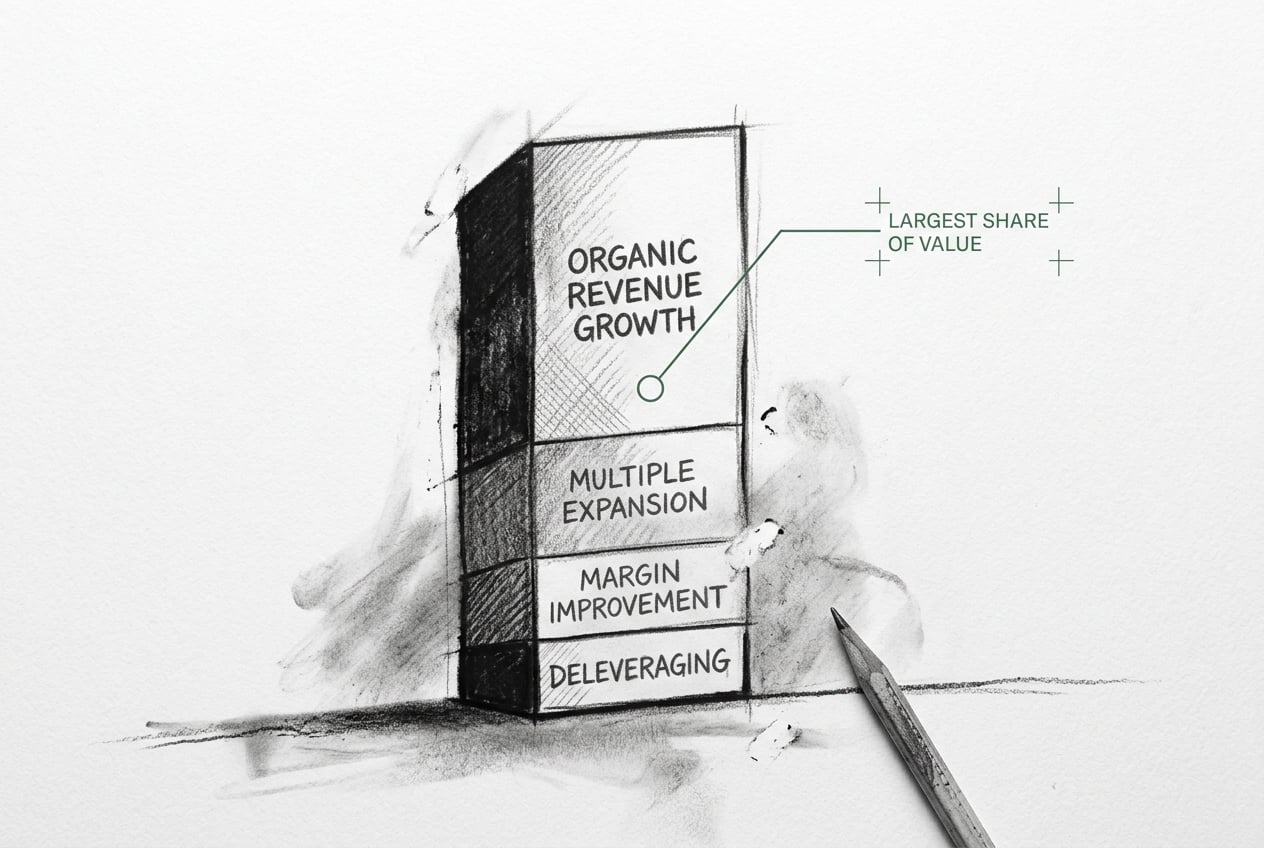
The easy money in private equity has been made. Bain and McKinsey now agree: future returns hinge on organic growth, the one lever most sponsors can't yet engineer.

Bain & McKinsey · private-equity value-creation research
01
The EBITDA Bridge

They have proven playbooks for three of four levers. Organic growth isn't one of them.

Every PE firm has the waterfall slide. Where EBITDA is now. Where it needs to be at exit. The gap, attributed across four levers: financial, operational, inorganic, organic. Three are systematized. The fourth is where the assumptions live.

FIG. I: EBITDA VALUE-CREATION BRIDGE
Today's EBITDA Target EBITDA at exit ↗
Current EBITDA today
+ Financial
Lever 1Cap structure, working cap, tax
+ Operational
Lever 2Cost-out, lean, shared services
+ Inorganic
Lever 3Bolt-ons, roll-ups, platform
+ ORGANIC ?
Lever 4New logos, expansion, complex sales
TargetEBITDA at exit
Engineered playbook
Soft assumption

Three of four levers are engineered, measured, and repeatable. The fourth is where the team plugs in numbers based on what the model needs to show, and where, three years in, you discover the sales team can't deliver what diligence assumed.
Source · Ed Marsh framing of the standard PE value-creation bridge. Quartile data from DealEdge / Bain, "Creating Value in Private Equity: Moving Beyond Multiple Expansion."
Charcoal stacked bar chart of private equity value-creation sources showing organic revenue growth as the largest share versus multiple expansion

The private equity landscape has fundamentally changed. Eager sellers, favorable supply-demand, and cheap debt supported a basic playbook of balance-sheet engineering, cost-cutting, functional efficiency, and bolt-ons. That world is over.

Sponsors now face compression from both sides. Buying habits and market conditions are shifting in ways that founders and family management have never navigated. Spreadsheet assumptions about aggressive new-logo acquisition and margin improvement repeatedly prove aspirational rather than realistic.

The fastest, most impactful response is to apply the same process engineering, continuous improvement, metrics-driven management, and operational rigor that already characterize PE improvements elsewhere, to marketing and, most of all, to sales.

"They've got a really good playbook for the first three. They don't have a good playbook for the organic growth." Ed Marsh · 24 February 2026
Explore the Bridge 6 resources

The Four Levers, Briefly

  • Financial: cap structure, working capital, tax
  • Operational: cost-out, lean, shared services
  • Inorganic: bolt-ons, roll-ups, platform thesis
  • Organic: new logos, expansion, complex sales
PDF

Quality of Sales

Ed's PE-facing brief. Buy Smarter. Grow Faster. Exit Stronger.
Read · ungated
ESSAY

Cycles & Secular Changes

Why 2025 was a watershed year for industrial sales and marketing.
Read

Why the Fourth Lever Fails

  • Plug-number assumptions, not modeled capability
  • Sales-team capability never diligenced
  • Founder-era playbook doesn't translate
  • Signal arrives 18+ months late
VIDEO

The EBITDA Bridge Explained

Five-minute walkthrough of the four levers and where the soft assumption hides.
Watch
COMING SOON

What PE Needs to Know

Ed's forthcoming guide for sponsors and operating partners. Coming soon.
Notify me
02
The Hold-Period Window

Whatever's broken in revenue takes eighteen months to surface.

Another twelve to fix. And most of an exit cycle to translate into multiple. The earlier the diagnostic, the bigger the lever. Here is where Ed engages, and what fails when he doesn't.

FIG. II: THE HOLD-PERIOD WINDOW
Stage I · Pre-Close

Acquisition

Diligence the target's sales team before you buy. Financial diligence checks the moat. Sales diligence checks whether the team can execute the thesis, and surfaces risks LBO modeling cannot see. 

Stage II · 0–100 days

Integration

The first hundred days set the ceiling on organic growth for the entire hold period. Process, methodology, and reporting installed early, not hoped for in year three.

Stage III · Year 2–4

Growth

When operations work, bolt-ons closed, and organic growth never showed up. The diagnostic, root cause and improvement roadmap, completes in roughly a month.

Stage IV · Year 4–7

Exit

Maximize value by demonstrating a sales engine that performs after you leave. Process, methodology, and hiring infrastructure that translate into multiple at sale.
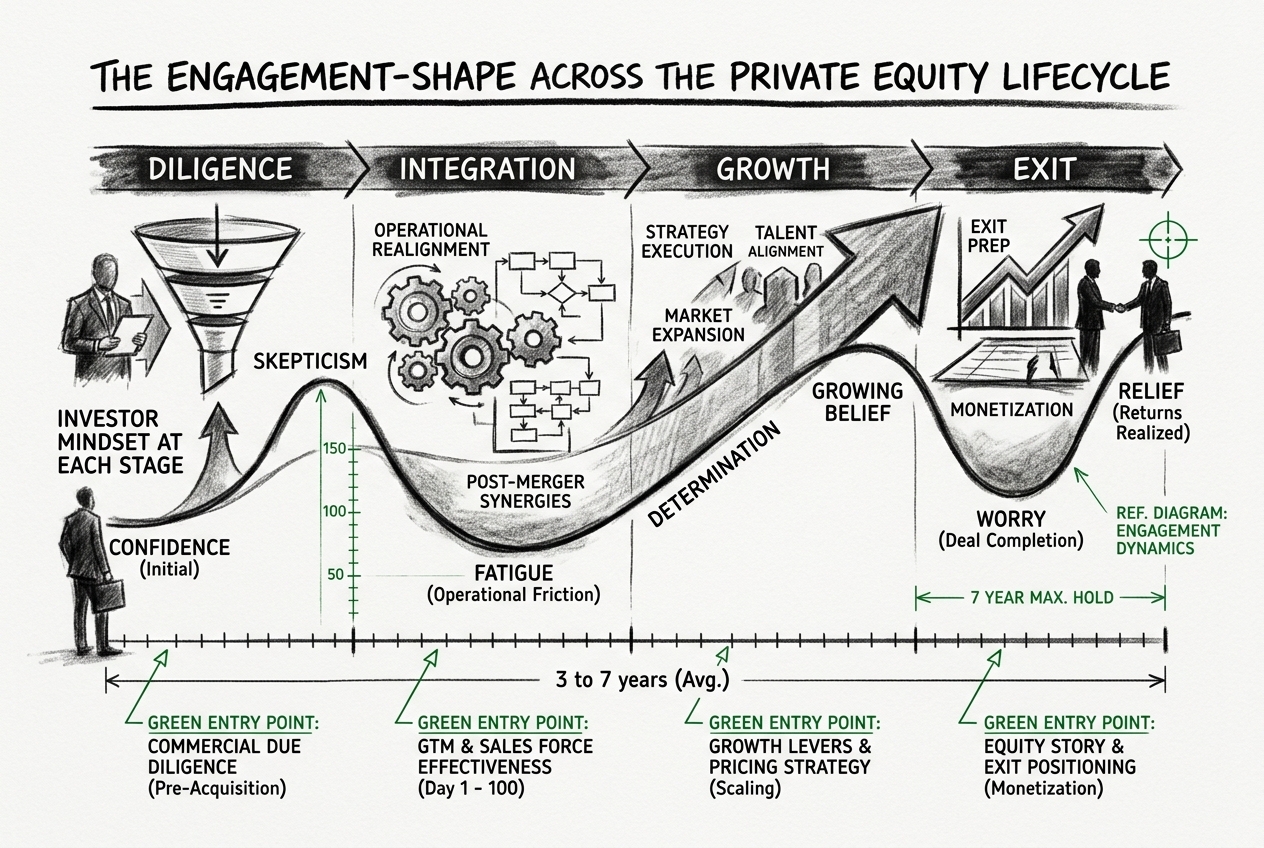
Charcoal timeline of the private equity hold period across diligence, integration, growth and exit with entry points for revenue-growth engagement

The hold period is finite. Whatever's broken in revenue takes 18+ months to surface, another 12 to fix, and most of an exit cycle to translate into multiple. The earlier the diagnostic, the bigger the lever.

Ed's most common engagement is the "three or four years in" call, when bolt-ons are working, operations are running, but organic growth never showed up. The Quality of Sales evaluation produces a detailed read on the existing organization in roughly a month, identifying root causes and a realistic improvement roadmap.

"So throughout that life cycle, I can help… they fit two different places in the story." Ed Marsh · 24 February 2026
Flagship Framework · Diligence · Integration · Growth · Troubleshooting

Quality of Sales

An empirical "MRI" of the sales team: the diligence-and-value-creation methodology that tells you whether the people you have can actually execute the thesis you underwrote.

Quality of Earnings diligence quantifies what has been. Models predict what will be. Quality of Sales answers the question in between: can this team deliver the new-logo acquisition and margin expansion the thesis assumes, and how long until you know? It empirically quantifies sales-team strengths and weaknesses at the individual and aggregate level, and it deploys across every deal phase. Built on Objective Management Group evaluation science. Not training. Not coaching. The diagnostic that comes before those decisions get made.

Predictive Validity by Hiring Method

Conventional sales-hiring tools are barely better than a coin toss.
Resumes & traditional interviews
18%
Behavioral / personality tests
20–22%
Reference & sales-skill screens
23%
IQ tests
51%
Sales-specific assessment
PREDICTIVE
What QoS Actually Measures

21 sales-specific competencies. Individual rep level. Team aggregate level.

The Sales Team Evaluation reads each rep's mindset and tactical ability, then assesses the team on coaching, recruiting, process adherence and accountability: a working read on whether the group can win new business, expand margin and satisfy the sales-related elements of the thesis.

It is not a personality or behavioral test. The data-science team continuously compares findings to field results, corroborated by biannual independent certification.

Deploys in:
Deal diligence · Post-close integration · Growth-mode troubleshooting · Pre-exit readiness
21
Sales-specific competencies assessed at the individual and team level
45 min
Per-person assessment time. The only ask of the existing team.
4–6 wk
Time to a complete organizational MRI with named recommendations
BUY SMARTER GROW FASTER EXIT STRONGER
FULL FRAMEWORK · ON SITE
Why is sales the least-measured part of your value bridge?
The QoS framework explained: why conventional sales hiring fails, what predictive assessment measures, and how it deploys across the four modes of the deal lifecycle.
11-PAGE PDF · UNGATED · SHARABLE
Need to brief your operating partners first?
Get the full Quality of Sales brief as a sharable PDF. Send it to operating partners, board members or portco leadership before the next organic-growth conversation.
ED IS AVAILABLE
Want Ed's read on a specific sales team?
Sharp diagnostic questions, honest answers. Ed will tell you whether the problem is people, process or strategy, or who he'd refer you to.
03
How Ed Engages

Project work and advisory. Sized to the situation.

Per-deal, on retainer across the portfolio, or embedded with a portco. Most engagements are project plus performance, scoped to the question, with a clear deliverable.

Engagement Shapes & Programs 8 ways Ed works
DILIGENCE · ~3 WK

Quality of Sales Diligence

Pre-close evaluation of the target's sales team. Modeling support for what the team can deliver against thesis assumptions. Risks financial diligence misses.
Engage
INTEGRATION · 100 DAYS

100-Day Sales Integration

Day one assessment. Week one quick wins. Month one process installation. Quarter one measurable improvements.
Engage
MID-HOLD · ~1 MO

Mid-Hold Diagnostic

When growth never showed up. Detailed read on the sales organization in roughly a month, with root cause and a realistic improvement roadmap.
Engage
HIRING · 4–8 WK

Engineered Sales Hiring

Predictive assessment, structured search, and onboarding. For VPs of Sales and individual contributors. Predictively accurate vs. resume-and-interview gut feel.
Engage
EXIT · ~6 WK

Exit Readiness Audit

Sales engine evaluation prior to sale process. Demonstrate a repeatable, scalable revenue motion to buyers. Translate sales discipline into multiple.
Engage

Portfolio Programs

  • Across-portfolio QoS deployment
  • Portco CEO revenue mastermind
  • AI tools for revenue growth program
  • Consolidated revenue reporting
  • Sales & marketing maturity benchmark
ADVISORY · BOARD

Independent Board Director

NACD and PDA certifications in governance and PE portfolio company governance. Board service for portcos where revenue growth is the open question.
Inquire
PLATFORM · ADVISORY

Publishing Bolt-On Strategy

Ed's contrarian thesis: one of the first bolt-ons in an industrial roll-up should be a struggling industry publisher. Buy the audience.
Read the case
Flagship Diagnostic · The Whole Revenue Engine

Overall Revenue Effectiveness™

If the sales team is struggling, the problem might not be sales. ORE audits the entire revenue engine (strategy, marketing, technology and sales) as one integrated system.

199
Yes/No Questions Across the Whole Revenue Engine
Corporate strategy (31) · Marketing (73) · Technology (47) · Sales (48). One honest read on where revenue actually leaks.
What ORE Actually Does

An audit of the whole revenue engine, not just sales.

Most industrial revenue problems aren't where management thinks they are. Sales gets blamed because sales is where the number gets missed. But the actual breakdown is usually upstream: marketing that doesn't deliver leads at real buying intent, technology that can't track lifecycle revenue, or a corporate strategy that doesn't map to who actually buys.

ORE is the revenue analog of the OEE rigor these companies already run on the shop floor. The default answer is "no." If you have to check with your team, that's also "no." If you have some of a list but not all, the answer is still "no." Companies that score high are rare, and they're the ones with predictable, scalable organic growth.

◆ ORE DIAGNOSTIC · Sample Questions
06 / 199

The default answer is "no." If you're not sure, the answer is no. If you have some of a list in place but not all, the answer is also no.

01
Defined ICP that incorporates size, geography, industry, growth trend, philosophy, ownership and problems to be solved
YESNO
02
Clear mapping of buying team, buying journey and key decision points for marketing and sales activity
YESNO
03
Marketing receives as much focus and attention as sales, with accountability for attributable revenue against investment
YESNO
04
All reps and managers are accountable for CRM use; no external reports are used to track projects and accounts
YESNO
05
Over 75% of the sales team made quota last year and are on track this year
YESNO
06
Every rep has a prospecting target to which they are individually accountable
YESNO
6 of 199 questions shown · The full diagnostic covers all four pillars in detail
FULL FRAMEWORK · ON SITE
Where is your revenue engine actually broken?
The ORE framework explained: how the four pillars interact, why fixing sales without fixing marketing usually fails, and what the maturity model looks like at each level.
PDF · 199 QUESTIONS · UNGATED
Want to score yourself against the model?
Get the full ORE diagnostic as a sharable PDF. Run it with your operating team or portco leadership and use the answers to drive the next conversation about where to invest.
ED IS AVAILABLE
Want Ed to walk through it with you?
Skip the self-assessment. Ed asks the diagnostic questions on a call and tells you which pillars matter most for your situation, and which can wait.
04
The Counterpoint

Ed knows what people say about industrial PE. He doesn't ignore it.

There are real critiques of how private equity has operated in industrial sectors. Some are accurate. Some are dated. Some apply to a different kind of fund than the ones Ed works with. Here are the four he hears most often, and how he thinks about each.

i.
The Strip-Mine Narrative
"PE buys companies, loads them with debt, sells the parts, and walks away with the cash."

Ed's view: That's the leveraged-buyout model from the 1980s, not the LMM industrial thesis. The sponsors Ed works with are trying to grow EBITDA, not strip and flip. The criticism is real for parts of PE; it's not real for the operators this site is written for.

ii.
The Short-Termism Critique
"Five to seven years isn't enough time to build real organic growth. PE sponsors optimize for exit, not for the business."

Ed's view: Partly fair. The hold-period constraint is real, which is exactly why diligence and integration matter so much. If you wait until year four to fix sales, the holding period is gone. The constraint is the argument for doing this work earlier, not against doing it.

iii.
The Spreadsheet-Management Critique
"PE doesn't understand the operating business. They understand financial models."

Ed's view: True for some sponsors. The ones who hire operating partners with industrial operating backgrounds get this. The ones who staff with finance generalists struggle. Ed's clients tend to be the former, by self-selection, not coincidence.

iv.
The Financial-Engineering Critique
"Multiple arbitrage and leverage aren't real growth. They just look like growth on a slide."

Ed's view: Bain and McKinsey now say this too. That's the entire setup for organic growth as the new value-creation lever. The criticism has become the consensus.

Forthcoming Guide · In Development

What PE Needs to Know About Organic Growth

Three levers are solved. This guide is about the fourth.

In development · not yet available to download
The Value-Creation Bridge · Four Levers
1
Financial
Cap structure, working capital, tax
✓Engineered playbook
2
Operational
Cost-out, lean, shared services
✓Engineered playbook
3
Inorganic
Bolt-ons, roll-ups, platform
✓Engineered playbook
4
Organic
New logos, expansion, complex sales
→The subject of this guide
Source · Ed Marsh framing of the standard PE value-creation bridge.
What the guide covers
01

Why the fourth lever fails

It runs on the number the model needs to show, not on capability anyone measured.

02

What financial diligence can't see

Diligence checks the moat and the margins. It has no line for sales-team capability.

03

The integration window most sponsors waste

The first hundred days set the ceiling on organic growth for the whole hold.

04

Reading growth risk before you buy

Revenue problems take eighteen months to surface. Surface them at the diligence table instead.

HubSpot Form
Notify me on release
We'll send it the day it publishes. One email, then nothing, no sequence.

Adds you to the waitlist for this guide only.
Ed is available · 15 min
Don't want to wait?
Ed works through these questions on calls every week. Bring yours now, straight answers.
Talk to Ed Now
05
Client Fit

Ed doesn't work with every PE firm. Here's how to know if a conversation is worth your time.

Sourced directly from Ed's ICP definition. PE-specific. The homepage version is broader.

FIT · ED WORKS WITH

Industrial PE sponsors who want real answers

  • LMM and middle-middle market: portcos $25M–$250M revenue, $2.5M–$30M EBITDA
  • Industrial focus: manufacturing & manufacturing-adjacent (controls, automation, AI for mfrs)
  • CONUS portfolio
  • Philosophy of sharing resources across the portfolio: informal portfolio resource group
  • Often military veteran leadership
  • Want empirical measurement, not opinion: process engineering applied to revenue
  • Willing to make changes based on data, even when uncomfortable
  • Value direct, honest assessment over polished consultant theatre
NOT A FIT · LOOK ELSEWHERE

Where the engagement won't land

  • Captive Portfolio Operations team that sees Ed as a conflict
  • Portco ELT (especially mid-level management) that doesn't want to change
  • Non-industrial focus: B2C, SaaS, services outside manufacturing
  • Looking for a fractional CMO or outsourced sales manager
  • Need someone to validate decisions already made
  • Want a 90-day engagement with no commitment to implementation
  • Expect results without changing process, people, or approach

If this is you, Ed will say so on the first call. Email Ed directly →

06
Reading List

Read before the call. Ed reads what you sent first.

Curated stack of Ed's writing for sponsors and operating partners. Two forthcoming guides previewed.
Ed Marsh, portfolio revenue growth consultant, in a navy blazer
MEET ED

Three decades inside industrial. PE-credentialed. Plain-spoken.

Consultant · Speaker · Director · Author · Veteran

Ed has spent his career inside industrial manufacturing: building, selling, advising, sitting on boards, and writing about what works. He works exclusively with lower-middle and middle-market industrial manufacturers and the private equity sponsors that own them.

He holds governance certifications from the National Association of Corporate Directors (NACD) and the Private Directors Association (PDA), including the PE Portfolio Company governance designation. The frameworks on this page (Quality of Sales, ORE) are the systems Ed has built over thirty years of watching the same problems play out at companies that should know better.

Johns Hopkins Airborne Ranger Qualified NACD Governance Fellow PDA · PE Portfolio Co. Governance Independent Board Director
Primary CTA · No Pitch · No Sequence

Talk to Ed About Your Sales Team

Sharp diagnostic questions. An honest read on whether Ed can help, and if he can't, who can.

An honest read on your sales team.

No pitch deck. No proposal cycle. No follow-up automation. Ed asks sharp diagnostic questions about your organic growth challenge and gives you an honest read on what's actually happening.

  • A clear next step, a better referral, or a few things you can do this week
  • Ed's read on whether your sales problem is people, process, or strategy
  • If Ed isn't the right fit, he'll tell you who is

Ed Marsh, industrial sales advisor, in a pink dress shirt
Ed Marsh
Consultant · Speaker · Director · Author · Veteran
✉ Prefer to leave Ed a message instead? No calendar, no obligation. Ed reads every message personally. ▼

Ed reads every message personally and usually responds within 24 hours.