
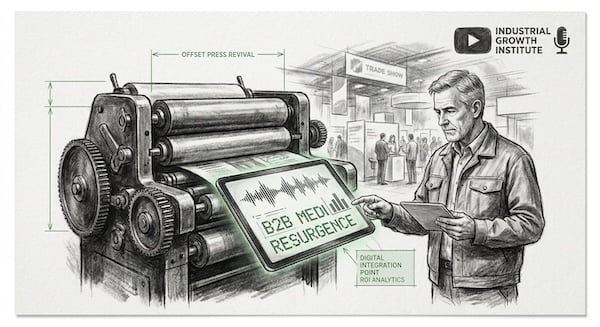
A recap of the Industrial Growth Institute podcast with Joe Angel
In 2015, SEO, content, and a digital inbound playbook looked unstoppable. Today website traffic and search volume are falling, and PR and trade media are quietly regaining ground. So who better to talk to than someone who has lived the whole arc? Joe Angel co-founded Summit Media in 1993, launched Packaging World in 1994, sold the company to PMMI (The Association for Packaging and Processing Technologies) in 2014, and now serves as PMMI's Executive Vice President of Industry Outreach. He has watched manufacturers use media well and badly for three decades, and he has strong opinions about what works now.
TL;DR
- Print was never really a lead-gen tool. It was a branding and awareness tool that happened to have bingo cards attached. When the cards disappeared, so did easy ROI measurement.
- The biggest mistake manufacturers make with media today: assuming they can market only to their own customers and that buyers already know who they are.
- Commercial messaging is commodity. "Everybody has the best machine." Third-party content, especially case studies, is what differentiates.
- Print, digital, and events work best integrated. PMMI's personalized "Game Plan" show guide is a working example.
- AI won't replace editors or experienced engineers. The real risk is losing decades of tacit knowledge as that generation retires.
Launching a print magazine when people said it was crazy
Joe started Summit with two partners after a publisher consolidation left the magazine he sold for in what he called "a jumbled mess."
- Summit formed in August 1993; Packaging World launched in 1994. His partner's first reaction to the idea: "You're crazy."
- Before the internet, trade magazines generated leads through bingo cards: readers circled a number on an ad and mailed the card in. That gave advertisers a clean count ("your ad got 56 leads").
- Packaging World bet on full-color presentation because packaging is a visual business and CPG readers asked for it. Competitors followed.
- Even in print's heyday, Joe sees its core job as branding and awareness, something he says it still does well.
The recession, not digital, forced the reinvention
You might assume the internet killed the trade magazine model. Joe's account is more nuanced.
- Summit didn't really feel digital pressure until 2008 and 2009, and the trigger was the financial crisis. Revenue fell roughly 25 to 30 percent, and the company cut six of its 30 people.
- With event space already booked and an event canceled, the team repurposed it as a free "Beyond Advertising" day to show customers email marketing, on-demand lead generation, and web offerings.
- Summit rolled out landing pages and one-click lead delivery: if a verified packaging engineer at a CPG clicked an email, that lead went straight to the advertiser.
- Manufacturers weren't asking for this. Summit was educating them, and that digital platform is what later made the company a strategic acquisition.
- Print itself kept posting record years well into the 2010s. The decline was "a very slow dripping type of leak," not a cliff. Revenue recovered fully by the end of 2011.
Who still reads print, and why ROI got harder to prove
- Engineering and purchasing readers held on to print longest, partly because tablets weren't allowed on plant floors.
- A 35-year-old engineer at a major CPG told Joe his team liked the paper edition because they could dog-ear it and come back later. Try that on a website.
- A page of advertising ran around $6,000 to $7,000. Once the bingo cards went away, buyers who saw an ad went to the supplier's website instead of calling, and the magazine never got credit.
- Digital was cheaper to produce, but it only delivered ROI when paired with a verified audience and real lead generation.
Why PMMI bought a media company
PMMI runs the PACK EXPO shows, some of the largest trade shows in the country. So why buy a publisher?
- The draw was Summit's digital lead-gen platform and content engine, plus its CPG readership and brand.
- The strategic logic: a trade show owns the audience for a week. Content keeps the association relevant the other 50 weeks of the year.
- PMMI had been planning to build its own digital platform. It chose to buy instead.
What manufacturers get wrong about media today
Joe's answer was immediate: companies think they can target only their own customers and expect prospects to know who they are.
- Bought lists (Dun and Bradstreet, ZoomInfo, and the like) don't solve it. Recipients don't know you, and email rules no longer allow blasting.
- Verified, permission-based audience data segmented by market, process, job title, geography, and company size lets manufacturers reach buyers beyond their existing base, and feed that data into their own CRM and marketing tools.
- Banner ads alone are ineffective. Contextual placement works better: an ad that appears when a reader searches a specific equipment type, or a matched ad in a subscriber's LinkedIn or Instagram feed.
- Whatever the channel, the message can't be a commercial. "Everybody has the best machine, everybody has the best price, everybody has the best service."
- The strongest asset is a case study showing what a real customer did with your equipment. White papers work too, unless suppliers make them too commercial (which they often do).
Integrating print, digital, and the show floor
Buyers no longer browse to stay current. They hunt for answers to pressing problems. PMMI's Game Plan is built for that.
- When attendees register for PACK EXPO, they indicate the industries and equipment categories they care about.
- PMMI uses that data to produce a digitally printed, personalized guide: "Hey Ed, thanks for registering. Here are the exhibitors to see," with a hall map highlighting relevant companies.
- Exhibitors can buy a page plus product spots showing what they'll have in the booth.
- At the most recent Las Vegas show, PMMI also stocked category versions (bagging and wrapping, coding and marking, palletizing) in bins on the floor. They "flew off the shelf."
- With roughly 2,700 exhibitors, nobody covers the floor without a plan. Joe calls it the first time a publisher built a print product on a digital data foundation.
Should manufacturers build (or buy) their own media operation?
Ed has long suggested manufacturers systematize their own content, or even bolt on a small media company, whether as a PE platform add-on or a mid-size manufacturer's acquisition. Joe's take:
- Size matters. Large companies can staff an in-house content operation. Most mid-size manufacturers can't, though member companies are getting more sophisticated.
- "Content is king" still holds. Third-party content carries credibility that self-promotion can't.
- Alternative, independent media isn't limited to news and entertainment. Expect more manufacturers shooting plant videos (with customer permission) and booth testimonials themselves.
- Specialized editors bring something a new marketing hire won't: years of experience with a specific technology and the ability to extract knowledge from experts.
How to spend $10,000 a month
Ed posed a scenario: a $50 million machinery company frees up $10,000 a month for media, with trade show spending held flat.
- Joe would run a mix: on-demand lead generation, selected social (LinkedIn and Instagram, not TikTok), email, search, contextual web ads, and print for ongoing name maintenance.
- For context, he estimates the average media customer spends about $20,000 to $25,000 a year. So $120,000 is a serious budget.
- Measure beyond site traffic: which content drove people to your website, and how many real leads resulted.
- On the leads-versus-sales blame game, Ed's view: some leads are junk, but not most of them. If sales says they're all junk, that's a sales problem.
- Two traps Joe sees: CEOs who cut print after reading a "print is dead" headline (while reading trade journals on Saturday mornings), and companies that skip experimenting because they've succeeded without it.
AI, editors, and the knowledge walking out the door
Editors feared AI would take their jobs. So far it hasn't, and Joe doesn't expect it to replace editorial judgment. His bigger worry is elsewhere.
"You can't think that AI is going to replace an engineer who's been at a company for 30 years, who's seen every foreseeable problem on a packaging line with a customer."
- Experienced engineers and field service technicians are retiring, and companies have no reliable way to transfer what they know.
- PMMI's 2025 workforce research points to a severe skilled-labor shortage, especially in field service.
- PMMI members can direct up to $50,000 through the association's skills fund to support education, from high schools and vocational schools to universities.
- Ed's parallel: a great editor knows how to question a subject matter expert. Whether you're writing a compelling story or capturing tacit knowledge for the next generation, it's the same skill, and most companies aren't good at it.
Relationships still close deals
- Some predict buyers will purchase from AI bots. Joe isn't buying it: "shaking a hand, looking someone in the eye, there's nothing like it."
- Kicking the tires on a machine at a show is no different from test-driving a car. Buyers want to see it.
- His parting advice: treat marketing as an investment, not an expense. Try new things, drop what doesn't work, and bring sales, operations, and even HR into marketing decisions.
What this means for you
If you're a PE sponsor, notice how often "marketing" in a portco means a trade show budget, some print, and a website nobody measures. Joe's story shows the companies that win treat audience, content, and events as one system and demand evidence of return. That's an operating discipline, not a line item to trim when a partner reads that print is dead. And Ed's bolt-on idea deserves a real look: a small media property in a niche vertical can give a platform an owned audience and content engine that competitors can't buy off the shelf.
If you're a CEO, stop marketing only to people who already know you. Your buyers are overwhelmed and hunting for answers, not browsing. Earn attention with case studies and third-party content, reach beyond your customer list with verified audience data, and measure what actually produces pipeline. Then fix the handoff so marketing and sales stop blaming each other for leads nobody worked.
That's the thinking behind Overall Revenue Effectiveness™ (ORE™): bringing the same rigor to your commercial engine that you already bring to OEE on the shop floor, including how media, content, events, and sales work together to create pipeline. If your marketing mix hasn't changed since search traffic started falling, it's time to look. If you're exhibiting at PACK EXPO, stop by the PMMI booth, or connect with Joe on LinkedIn. The full conversation with Joe Angel is on the Industrial Growth Institute podcast.
FAQ
Is print advertising dead for industrial manufacturers?
No. According to Joe Angel, founder of Packaging World, print's decline in B2B has been a slow leak rather than a collapse, and it remains effective for branding and keeping a supplier's name in front of buyers. Engineers and purchasing professionals in particular have valued print editions they can mark up and return to. Its weakness is measurement, not reach.
What is the biggest media mistake manufacturers make?
Marketing only to existing customers and assuming prospects already know who they are. Bought contact lists don't solve this, because recipients have no relationship with the sender and email regulations restrict mass outreach. Verified, permission-based audience data from trade media lets manufacturers reach qualified buyers beyond their current base.
What kind of content works best for industrial B2B marketing?
Customer case studies. Every supplier claims the best machine, price, and service, so commercial messaging doesn't differentiate. A case history showing how a named customer used the equipment and what improved is the most credible testimonial available. Third-party content from a trade publication adds further credibility and can be repurposed across email, social, and a company's website.
How should a mid-size manufacturer spend a media budget?
Joe Angel recommends a mix: on-demand lead generation, selected social platforms such as LinkedIn and Instagram, email, search engine marketing, contextual web ads, and print for ongoing brand presence. He estimates the typical trade media customer spends about $20,000 to $25,000 a year. Results should be measured in content-driven site visits and qualified leads, not just traffic.
Can AI replace trade publication editors or experienced engineers?
Joe Angel doesn't think so. AI can surface best practices, but it can't replicate an engineer who has spent 30 years solving problems on packaging lines, or an editor's judgment and ability to draw knowledge out of experts. The bigger risk for manufacturers is losing that tacit knowledge as experienced workers retire without a way to transfer it.
Why do trade shows still matter for industrial buyers?
Buyers of capital equipment want to see and evaluate machinery in person, much as they'd test-drive a car. Face-to-face relationships remain central to industrial sales. Integrated tools such as PMMI's personalized Game Plan show guide help attendees plan which exhibitors to visit, making the show floor more productive for both buyers and suppliers.
- Most complex industrial purchases must clear five separate buying decisions.
- Decisions 2 and 3 determine whether a purchase happens at all — and most reps don't know they exist.
- Most big-ticket B2B industrial forecasts are fantasies because they ignore those decisions.
- Buying teams typically include eight to twelve people.
- Reps need business acumen — not just product knowledge — to engage decision-makers early.