
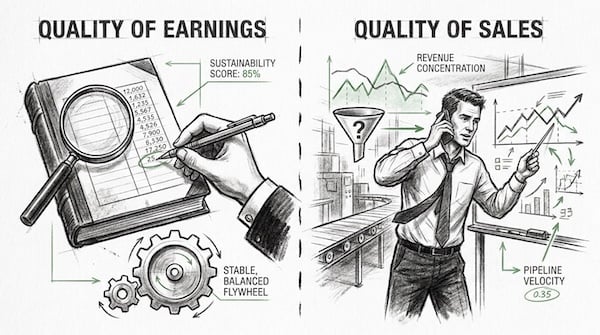
Quality of Earnings validates whether historic EBITDA is real and sustainable. Quality of Sales (QoS) assesses whether the commercial engine can predictably and repeatedly create profitable growth to support future EBITDA and exit value. One is a look in the rear-view mirror; the other is a look at the road ahead.
TL;DR
- Quality of Earnings (QoE) is a standard, backward-looking financial due diligence process. It verifies that a company’s past reported earnings are accurate, sustainable, and have been normalized for any non-recurring events. It answers the question: "Is the historical financial performance real?"
- Quality of Sales (QoS) is a forward-looking operational due diligence process. It assesses the health and scalability of a company’s revenue engine, including its positioning, marketing, sales process, pipeline management, talent, and go-to-market strategy. It answers the question: "Can this company achieve the organic growth promised in the investment thesis?"
- For private equity sponsors, QoE validates the entry multiple and protects the initial investment. QoS, however, is what determines the exit multiple and the ultimate return.
- Ignoring QoS is a common and costly mistake. It’s how PE firms end up with portfolio companies that look great on a spreadsheet but have a fundamentally broken commercial engine, putting the entire value creation plan at risk.
The Familiar Comfort of the QoE
In any middle-market industrial deal, the Quality of Earnings report is table stakes. It’s a foundational piece of financial due diligence, and for good reason. Before you write a check, you need to know if the numbers you based your valuation on are legitimate.
- Confirm historical earnings are accurate.
- Identify and adjust for non-recurring revenue or expenses.
- Analyze the quality of working capital.
- Validate the company’s accounting policies and procedures.
It’s an exercise in verification. The QoE tells a PE sponsor that the asset they are buying is, in fact, what the seller claimed it was. It protects the downside. It’s a necessary, rigorous, and well-understood process.
But it tells you almost nothing about the future.
Quality of Sales: The Missing Piece of the Value Creation Puzzle
A favorable QoE confirms you have a solid foundation. But your investment thesis isn't built on maintaining the foundation; it's built on building a structure of predictable CAGR on top of it. That’s where Quality of Sales comes in.
QoS is the rigorous, data-driven assessment of the company’s ability to generate future organic growth. It moves beyond the financial statements to inspect the machinery of the revenue engine itself. While a CFO lives in the world of QoE, a CEO or CRO must live in the world of QoS.
A proper QoS diligence process exposes the rot that financial reports can’t see. It diagnoses the systemic issues that prevent so many PE-backed industrial companies from hitting their growth targets. Ignoring Quality of Sales can lead to portfolio companies with fundamentally broken commercial engines.
What Does a Quality of Sales Assessment Uncover?
When we go inside these companies, we see the same patterns repeat. The financial models are sophisticated, but the sales operations are run on gut feel and outdated assumptions.
A QoS analysis typically reveals that:
- The company can’t consistently win new logos. Often, 70% or more of revenue comes from the same repeat customers. This is celebrated as loyalty, but it’s a massive red flag. It shows a sales team optimized for account maintenance, not new business acquisition, which is fatal to a growth-oriented investment thesis.
- The sales team is chronically underperforming. It’s common to find that 40 to 60% of sales reps consistently miss quota. This is almost never an individual performance issue. It’s a systemic failure of hiring, management, and process.
- The pipeline is a fantasy. Forecasts are unreliable because there’s no formal sales process, no clear pipeline stages, and no objective criteria for qualifying an opportunity. The pipeline is full of deals imagined by sales reps' "happy ears" that have a low probability of closing, and management has no way to tell the difference.
- Sales leadership is ineffective. Many sales leaders were promoted because they were good reps, not because they can manage, coach, and build infrastructure. They often don’t build playbooks, implement a methodology, or hold people accountable because they’ve never been trained to. In their earlier jobs they were simply there. This is often the result of a broken hiring process that overvalues industry experience and undervalues management competence. A QoS assessment often pinpoints this as a root cause, showing that the company needs a completely different approach to Sales Talent Hiring & Recruiting to break a cycle of failed hires that can consume years of a five-to-seven year hold period.
- The team is playing a game it can’t win. Most industrial sales reps are taught to "find projects" by chasing active RFPs. But data shows that in complex sales, the buyer has often built a shortlist and has a preferred vendor in mind before they ever speak to a salesperson. The winning strategy is to "create projects" by engaging buyers early, but most teams aren’t built or trained to do this.
The Dangerous Disconnect Between Financial Rigor and Sales Negligence
The great irony in many PE portfolio companies is the stark contrast between operational discipline and commercial chaos.
A manufacturer would never tolerate a 40% defect rate on its production line. It would be considered an existential crisis. Yet, that same company accepts a 40% failure rate in its sales organization, where reps consistently miss quota. They apply Six Sigma to operations but run sales on assumptions and anecdotes.
This disconnect is where value creation plans go to die. The "bridge slide" in the deck that shows a path from entry to exit EBITDA is based on a projected growth rate. The QoE confirms the starting point of that bridge. The QoS determines if you can actually build the bridge at all with the existing team, and what will be required to do so.
Without a clear-eyed view of the sales engine’s true condition, the growth assumptions in the financial model are just wishful thinking. I help sponsors and operators focus on this gap because it represents the single biggest unmanaged risk in most middle-market industrial investments. Bringing operational-level rigor to the sales function isn’t a nice-to-have; it's the prerequisite for executing the plan.
Said differently, this is a massive opportunity for alpha creation.
QoE Protects the Investment, QoS Delivers the Return
Ultimately, the distinction is simple.
Quality of Earnings answers the question: "Are we buying what we think we are?"
Quality of Sales answers the question: "Can this asset (GTM engine) do what we need it to do?"
In the world of private equity, you get paid for the second answer, not the first. This is where you create alpha. For PE sponsors and portfolio company leaders, understanding the Quality of Sales is no longer optional. It is the core of responsible governance and the only reliable path to value creation.
Frequently Asked Questions
What is the difference between Quality of Earnings and Quality of Sales?
Quality of Earnings (QoE) validates whether historic earnings like EBITDA are real and sustainable, focusing on past financial performance. Quality of Sales (QoS) assesses the ability of the company's sales engine to generate future growth, focusing on operational and sales strategies.
Why is Quality of Sales important in private equity?
Quality of Sales is crucial because it determines the ability of a company to achieve the growth outlined in its investment thesis. It addresses systemic sales issues and helps predict future revenue growth, which is key to driving exit value and returns in private equity investments.
What common issues does a Quality of Sales assessment uncover?
A Quality of Sales assessment often reveals that companies rely heavily on existing customers, suffer from underperforming sales teams, have unreliable sales forecasts, and face ineffective sales leadership, all of which hinder future growth potential.
How does the disconnect between operational discipline and sales negligence affect private equity investments?
This disconnect compromises value creation plans as rigorous operational standards don't extend to sales processes. Without a reliable sales engine, the assumed growth in financial models is not achievable, jeopardizing the investment's potential returns.
- Most complex industrial purchases must clear five separate buying decisions.
- Decisions 2 and 3 determine whether a purchase happens at all — and most reps don't know they exist.
- Most big-ticket B2B industrial forecasts are fantasies because they ignore those decisions.
- Buying teams typically include eight to twelve people.
- Reps need business acumen — not just product knowledge — to engage decision-makers early.