
A recap of the Industrial Growth Institute podcast with Pete Caputa, CEO of Databox
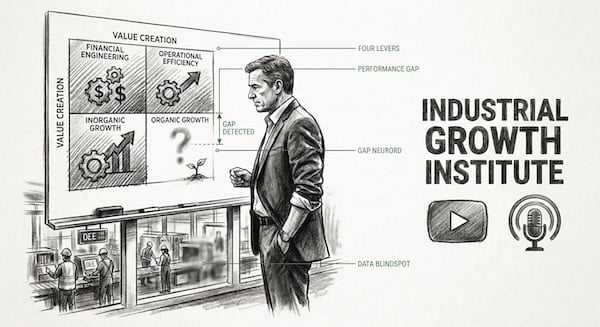
Most private equity investment theses model four ways to create value: tighten the balance sheet, run the operation leaner, bolt on an acquisition, or grow revenue organically. Three of those have institutional discipline behind them, with well developed playbooks, specialists, KPIs. The fourth usually gets a slide in the deck and a hope.
I brought that gap to a conversation with Pete Caputa, CEO of Databox and the 15th employee at HubSpot, and what came out of it was blunter than I expected: based on Pete's experience, sponsors aren't just underinvesting in organic growth, a lot of them can't even see how their portfolio companies are actually performing.
TL;DR
- Most PE and VC sponsors don't track portfolio company performance closely. Pete Caputa says so directly, and he contends and it's costing them now that valuations have plateaued and exits are stretching out
- The "failure stack" inside industrial portcos: no sales math, garbage-in CRM and forecast data, and IT/security functions that treat new data initiatives as risk instead of opportunity
- The fix is Pete's five-step SPEARS framework — Strategize, Plan, Execute, Adjust, Repeat/Scale — built with the portco team, not imposed on them
- Inbound marketing as a standalone strategy is dead. Winning now takes multi-channel, multi-format, multi-perspective content; the same content that gets cited by AI answers instead of buried under someone else's SEO
Four levers, one gets ignored
Every PE investment thesis rests on four levers of value creation:
- Financial engineering — tighten receivables and payables, restructure debt
- Operational efficiency — Six Sigma, black belts, OEE on the shop floor
- Inorganic growth — bolt-ons, adjacencies
- Organic growth — new logo acquisition, price, expansion
The first three have mature playbooks and people whose whole job is executing them. The fourth gets a bar on the value creation bridge slide in the deck and then mostly gets assumed. That's the gap Pete and I spent an hour poking at.
PE firms don't watch the number that matters most
Pete didn't hedge on this one:
"I think a lot of PE firms and VC firms don't pay attention to the performance of their companies very closely."
— Pete Caputa, CEO, Databox
A few data points on how that shows up:
- Databox picked up a handful of PE and VC firms as customers almost by accident as a byproduct of building cross-client visibility tools for marketing agencies managing dozens, sometimes thousands, of client accounts
- Pete tried selling directly into PE and VC a few years back. He walked away after having too many conversations that went nowhere
- That's changing now. Peak-era valuations, growth that's stalled or reversed, and exits getting pushed out are forcing the issue
My read, and I said it on the episode: this isn't a nice-to-have anymore. It's biting sponsors right now.
What actually breaks, portco by portco
Pull the thread on why sponsors are flying blind, and it's not one problem — it's a stack of them:
- No sales math. Most portcos have never worked backward from the value-creation milestone to the prospecting activity required to hit it. Brilliant financial and operational people, zero funnel math.
- Garbage-in forecasts. Poorly defined ICP, undefined buying teams, product-pitch selling instead of consultative, lack of sales process and methodology, missing playbooks and sales talent optimization, limited coaching (especially role-playing) cursory opportunity qualification. The forecast is only as good as what gets entered, and what gets entered is usually aspirational and the product of "happy ears."
- CRM discipline that doesn't exist. Pete's example: a sales leader who inherited a team that won't use the CRM, because the CEO won't force it. My example, which still amazes me: a sales team that used LinkedIn messaging specifically so the company couldn't track their activity even in their email exchange server.
- IT and security functions running fixed-mindset, not growth-mindset. Their job is safeguarding the company, not growing it. Any new data initiative reads as risk, not opportunity.
Pete's line on all of it: "This is a problem I see. I actually see this one." Not theoretical.
Measure the right thing, not just something
Two ideas from the conversation worth stealing directly:
- Goodhart's Law in action. Pete's HubSpot example: marketing was measured on demo requests. An ebook download page also had a "request a demo" button, and people filled it out by mistake trying to get the ebook. Marketing got credit for a lead that wasn't one. Measure the wrong thing and people will hit the number while missing the point.
- Amazon's weekly business review. The practice Bezos built to keep Amazon focused on the KPIs that actually predict outcomes, not vanity metrics that just look good on a slide.
- Correlation isn't causation. Pete's caution, which I pushed on hard: if outbound looks weaker than inbound in your data, that might mean inbound wins. Alternatively, it might mean you have strong marketers and weak salespeople. Data prompts questions; it doesn't answer them by itself. You still have to be, in Pete's words, "in the coal face" watching the actual work, not just the dashboard.
The fix: Pete's five-step framework (SPEARS)
Pete's new course lays out a five-step sequence — and the discipline is in not skipping ahead:
- Strategize — revisit the long-term vision, define who you serve better than anyone else
- Plan — turn strategy into annual objectives and goals
- Execute — do the unglamorous, repetitive work
- Adjust — revise based on what the data shows
- Repeat and Scale
His pointed advice for sponsors specifically: don't walk into a newly acquired portco with 17 new Salesforce reports in week one. You just told the team nothing would change. Build the strategy with the team as the first act of ownership instead, so everyone's bought in before you start measuring them against it.
He also drew a distinction most people get wrong: tracking your own historical trend is not benchmarking. Real benchmarking means comparing performance against a population of similar companies. That's a different, and far more useful question for a sponsor evaluating a portco, or diligencing a new one.
The other half: inbound marketing is dead for industrial portcos
Pete called this years before it was popular, when it cost him his own first ICP - marketing agencies. His position hasn't changed: inbound marketing as a standalone strategy no longer works. Too much global competition, too much noise, and Google's dominance as the free, efficient path to market is over. People are getting answers straight from ChatGPT, Gemini, and AI overviews instead of clicking through.
Databox's own funnel proves it:
- Roughly a third referral and repeat business
- A third paid search and ads. They've had to spend real money, seven figures a year, to replace lost organic
- A third everything else: LinkedIn, YouTube, podcasts, forums, Slack communities
What replaces inbound, per Pete, has to be three things at once:
- Multi-channel — not just the one platform that used to work
- Multi-format — written, audio, video, not just one
- Multi-perspective — the one most people skip. Social rewards repetition, but nobody wants to hear the same voice say the same thing on repeat. Bring in customers, partners, even competitors' prospects; in other words, other perspectives, not just your own.
Pete argues persuasively that the fuel for all of it is primary research - surveys, real quotes, case studies, partner-created content. Databox has run this playbook for nine years. It's also, not coincidentally, exactly the kind of citable, quotable, original content that shows up in AI answers instead of getting buried under someone else's SEO-optimized listicle. For many industrial portcos, that's a large piece of the marketing ballgame now: differentiation through content AI systems actually cite, not just content that used to rank.
What this means for you
If you're a sponsor: the same rigor you apply to OEE on the shop floor needs to apply to revenue. If you can't see it, you can't manage it, and right now, most sponsors can't see it.
If you're a portco CEO: your CRM discipline, your sales math, and your ICP clarity aren't nice-to-haves your sponsor will get around to eventually. They're what stands between you and a clean exit at the multiple everyone modeled.
This is exactly the gap Overall Revenue Effectiveness™ (ORE™) and Quality of Sales are built to close — bringing the same discipline to revenue growth that PE already applies to operations. The full conversation with Pete is on the Industrial Growth Institute podcast. His Predictable Scale course, which walks through the SPEARS framework in detail, is at databox.com/predictable-scale.
FAQ
Why don't private equity firms track portfolio company performance closely?
Most sponsors built deep discipline around financial engineering and operational efficiency, but organic revenue growth never got the same investment in systems or accountability. Databox CEO Pete Caputa says plainly that a lot of PE and VC firms don't watch portfolio performance closely - it simply hasn't been treated as a core diligence and oversight function the way EBITDA and operating metrics have.
What is the SPEARS framework?
SPEARS is Pete Caputa's five-step sequence for building a data-driven growth strategy: Strategize (revisit the long-term vision and define who you serve better than anyone else), Plan (turn strategy into annual objectives and goals), Execute (do the unglamorous, repetitive work), Adjust (revise based on what the data shows), and Repeat and Scale. The discipline is in not skipping ahead to Scale before the earlier steps are in place.
Is inbound marketing dead?
As a standalone strategy, yes — that's Pete Caputa's position, and Databox's own funnel backs it up. Global competition and AI-driven search (ChatGPT, Gemini, AI overviews) have eroded the free, efficient path organic search used to provide. What works now is multi-channel, multi-format, multi-perspective content, fueled by primary research rather than a single-channel SEO play.
What's the difference between benchmarking and tracking historical trends?
Tracking your own trend over time tells you whether you're improving relative to yourself. Real benchmarking compares your performance against a population of similar companies, which is a fundamentally different, and more useful, question for a sponsor evaluating a portco or diligencing a new one.
What is Goodhart's Law and why does it matter for PE-backed companies?
Goodhart's Law holds that once a measure becomes a target, it stops being a good measure. Pete Caputa's HubSpot example: marketing was measured on demo requests, so when an ebook download page also had a "request a demo" button, people clicked it by mistake and marketing got credit for a lead that wasn't real. Portcos that measure the wrong KPI get people optimizing for the number instead of the outcome it was meant to represent.
- Most complex industrial purchases must clear five separate buying decisions.
- Decisions 2 and 3 determine whether a purchase happens at all — and most reps don't know they exist.
- Most big-ticket B2B industrial forecasts are fantasies because they ignore those decisions.
- Buying teams typically include eight to twelve people.
- Reps need business acumen — not just product knowledge — to engage decision-makers early.