
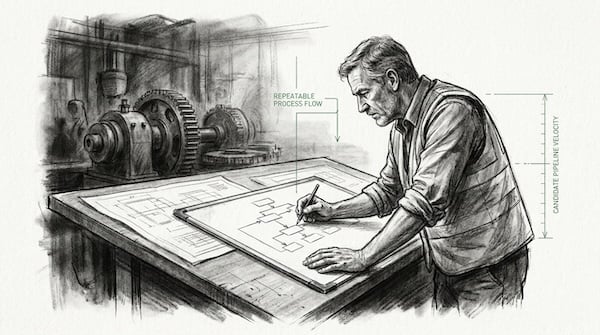
You build a repeatable industrial sales hiring process by treating it like a manufacturing process: define the required outputs (revenue), model the inputs (sales competencies and activities), and build a standardized system of evaluation with feedback loops to continuously improve the outcome. Stop hiring for resumes and start engineering for results.
TL;DR
- The Default is Broken: Most industrial companies hire for two criteria: industry experience and network referrals. Both are deeply flawed and unreliable predictors of success, and they drive the two-year failed sales leader cycle that sinks PE value creation plans.
- Model First, Hire Second: Before you write a job description, model your sales funnel. Quantify the specific activities, conversion rates, and deal velocities required to hit your revenue target. This defines what "good" actually looks like for a sales role in your company.
- Hire for Competency, Not Experience: Shift your evaluation from what a candidate has done (titles, industries) to what they WILL do. Focus on core competencies like selling business outcomes, "creating" projects instead of just "finding" them, and building sales infrastructure.
- Standardize the System: Create a structured interview process with a competency-based scorecard. Every candidate goes through the same stages and is evaluated against the same objective criteria. Gut feel is the enemy of repeatability.
- Audit the Environment: A great hire in a broken system will fail. Assess your own infrastructure. Do you have a defined sales process, a coaching-focused management layer, and clear accountability? If not, you are hiring for failure.
The Conventional Wisdom on Sales Hiring (And Why It’s Broken)
Ask the leadership team at most middle-market industrial manufacturers, distributors, and service providers how they hire salespeople, and you’ll get the same two answers: industry experience and referrals.
The logic seems sound. Hire someone who knows the products, the customers, and the competitors. Better yet, hire them from a competitor so they bring a Rolodex. We’ve all done it. We’ve all seen it fail, over and over.
This is the pattern that plays out constantly. A company, often a PE-backed portfolio company with an aggressive value creation plan, hires a new VP of Sales based on a great resume from a well-known industry player. Eighteen to twenty-four months later, with organic growth stalled and the new logo acquisition targets missed, they make a change. Then they run the exact same play again, hiring another candidate with the “right” industry background.
For a PE sponsor on a five-to-seven year hold period, two of these cycles consume more than half of the value creation timeline. The investment thesis is dead before it ever had a chance.
The belief that industry experience is the key to sales success is a dangerous relic. It produces candidates who are well-marinated in their own perspective but often lack the critical skills needed for modern industrial B2B growth. They know how to talk about products with plant engineers but lack the business acumen to sell a financial outcome to a CFO.
They know how to respond to RFPs, but they don't know how to get in front of the RFP to shape the buying vision. They are stuck "finding projects" when the real money is in "creating projects."
And while they may have had apparent success at some point in their career, it's difficult using casual sales screening techniques to determine whether that success was a product of their skill, or circumstances. Further, if it was skill, is that skill set appropriate for today's market zeitgeist and expectations?
Hiring based on industry experience is a cyclical trap. It’s time for a secular change in thinking.
Stop Hiring for Resumes and Start Hiring for Competencies
A repeatable process is, by definition, an engineered one. You would never tolerate a 40% defect rate on your production floor, yet most companies accept that 40 to 60% of their sales reps chronically miss quota. This isn’t a rep problem. It’s a hiring system problem.
Building a better system requires a fundamental shift from vetting resumes to validating competencies. Here’s how to do it.
Step 1: Define What "Good" Actually Looks Like (Quantitatively)
Before you even think about writing a job description, model your sales funnel. What are the specific, non-negotiable activities a rep must perform daily, weekly, and monthly to hit their number?
- How many outbound touches are required to generate one qualified meeting?
- What is your win rate on qualified opportunities?
- What is your average deal size and sales cycle length?
Despite the financial and modeling sophistication of most PE-backed companies, this basic funnel math is rarely done. Without it, you’re just guessing. Once you model the funnel, you can define the profile. A role that requires 100 cold calls a day to hit its number demands a different set of skills and motivations than a role focused on managing six complex, high-value deals a year.
That model is then translated into a performance-based job description, and later into a job posting designed to attract the right candidates.
Step 2: Build a Competency-Based Scorecard
Your scorecard should ignore industry experience and focus entirely on the skills that actually predict success in a long-cycle, complex industrial sale.
Evaluate every candidate against these core competencies:
- Business Acumen: Can they hold a credible conversation about business outcomes (e.g., EBITDA impact, risk reduction, throughput) with an executive buyer, or are they only comfortable talking specs with a technical buyer?
- Prospecting Philosophy: Do they prospect to "create projects" by engaging buyers early in their journey, or do they only know how to "find projects" by chasing active RFPs where they are already late to the game?
- Process Discipline: Can they articulate their personal process for pipeline management, opportunity qualification, and forecasting? A-players operate with a system. B- and C-players talk about relationships.
- Management & Coaching (for leadership roles): Have they built and scaled a team? Can they describe their coaching cadence, their pipeline review process, and how they hold reps accountable? Great VPs of Sales are great managers, not just great reps who got promoted.
- AI Innovation to Boost Effectiveness: Can they provide examples of capabilities they've created to use AI not just to improve efficiency (automate tasks - and look for some sophistication here) but more importantly to extend their capability. Do they describe agents and skills with a harness as colleagues? Or as bolt on tech tools?
Step 3: Standardize the Interview Process to Test for Those Competencies
A standardized process removes bias and allows for objective comparison. Every candidate should go through the same stages, with specific exercises designed to test the core competencies on your scorecard.
- The Lost Deal Debrief: Ask them to walk you through a significant deal they lost in the last year. Listen for accountability. Do they blame the buyer, the price, or the product? Or do they demonstrate self-awareness about what they could have controlled and done differently?
- The Pipeline Audit: Give them a sanitized version of a real pipeline report and ask for their analysis. What questions do they ask? How do they assess what’s real and what’s not? This reveals their ability to qualify and forecast.
- The Mock C-Suite Call: Role-play a call where you are the CFO of a prospect company. See if they can pivot from a product discussion to a business discussion.
Get my guide to common sales hiring mistakes and how to fix them.
The System Around the Hire Determines Success or Failure
You can make the perfect hire, and they will still fail if they walk into a broken system. Most middle-market industrial companies lack the basic infrastructure for a sales leader or rep to succeed.
There is often no defined sales process, no sales methodology, no playbooks, and no culture of coaching or accountability. A new leader is expected to build everything from the ground up while simultaneously hitting a revenue number. They are being set up to fail.
This is why my Sales Talent Hiring & Recruiting engagements start with an audit of the surrounding environment. We have to know if the company is ready for the A-player it wants to hire. A hiring process that ignores the operational reality of the sales organization is just rolling the dice with a PE sponsor's value creation timeline.
Making the Process Repeatable: From Gut Feel to System
The final step is to create a feedback loop. After you make a hire using your new process, track their performance rigorously against the competencies you scored them on during the interview process.
- Where were your scorecard predictions accurate?
- Where were they wrong?
- How can you adjust your interview questions or evaluation criteria to be more predictive next time?
This is how you turn hiring from an art into a science. Whether you build this capability internally with coaching or work with me to build the internal muscle and manage the process fractionally to help get started, the goal is the same: to turn a high-stakes, gut-feel decision into a repeatable, engineered system.
Industrial sales hiring isn’t a recruiting problem. It's a leadership problem disguised as one.
Frequently Asked Questions
Why is hiring based on industry experience ineffective for industrial sales roles?
Hiring based on industry experience is ineffective because it often leads to candidates who lack the critical competencies needed for modern industrial B2B growth. Industry experience focuses on product knowledge but overlooks the ability to sell financial outcomes, navigate complex sales processes, and 'create' projects rather than only 'finding' them.
What should be included in a competency-based scorecard for hiring salespeople?
A competency-based scorecard should focus on evaluating core skills essential for industrial sales success. A core component is a sales-specific sales candidate assessment that measures sales, sales management and sales leadership competencies. Key competencies include business acumen, prospecting philosophy, process discipline, and management & coaching capabilities for leadership roles. The scorecard should ignore industry experience and aim at skills that predict success in complex sales.
How can a company ensure that their sales hire will succeed?
To ensure a sales hire succeeds, a company must assess its own sales infrastructure, including having a defined sales process, a coaching-focused management layer, and clear accountability. Without these elements, even a perfect hire can fail due to systemic issues in the organization.
What are steps in creating a repeatable hiring process?
Creating a repeatable hiring process involves defining quantitative goals for what a successful hire looks like, building a competency-based scorecard, standardizing the interview process to test for those competencies, and establishing a feedback loop to refine and improve the process based on actual performance metrics.
- Most complex industrial purchases must clear five separate buying decisions.
- Decisions 2 and 3 determine whether a purchase happens at all — and most reps don't know they exist.
- Most big-ticket B2B industrial forecasts are fantasies because they ignore those decisions.
- Buying teams typically include eight to twelve people.
- Reps need business acumen — not just product knowledge — to engage decision-makers early.