PE M&A Activity ↑12.4%│ Industrial EBITDA Multiples 7.2×│ B2B Buyer Trust Index ↓31%│ SEO Click-Through Rate ↓44%│ LMM Deal Volume ↑8.1%│ Sales Hire Failure Rate 67%│ Organic Growth Gap 2.3× plan│ PE Dry Powder $2.59T│ PE M&A Activity ↑12.4%│ Industrial EBITDA Multiples 7.2×│ B2B Buyer Trust Index ↓31%│ SEO Click-Through Rate ↓44%│ LMM Deal Volume ↑8.1%│ Sales Hire Failure Rate 67%│ Organic Growth Gap 2.3× plan│ PE Dry Powder $2.59T│
Ed Marsh Consulting · Sales Force Evaluation

Do You Have the Right Salespeople:
In the Right Roles, With the Right Skills?

Every dollar you put into marketing, lead gen, software, and ads fails to convert to revenue unless three questions are answered, and acted on.

Missed quotas, margin erosion, slow lead follow-up: those are symptoms. A sales force evaluation finds the root cause (whether the problem is the people, the roles, or the skills) and gives you the data to fix it.

We often hire people we like and whom we hope can sell. Instead we need to hire and develop people who will sell.

Ed Marsh, Sales Force Evaluation
The Question Behind the Symptoms

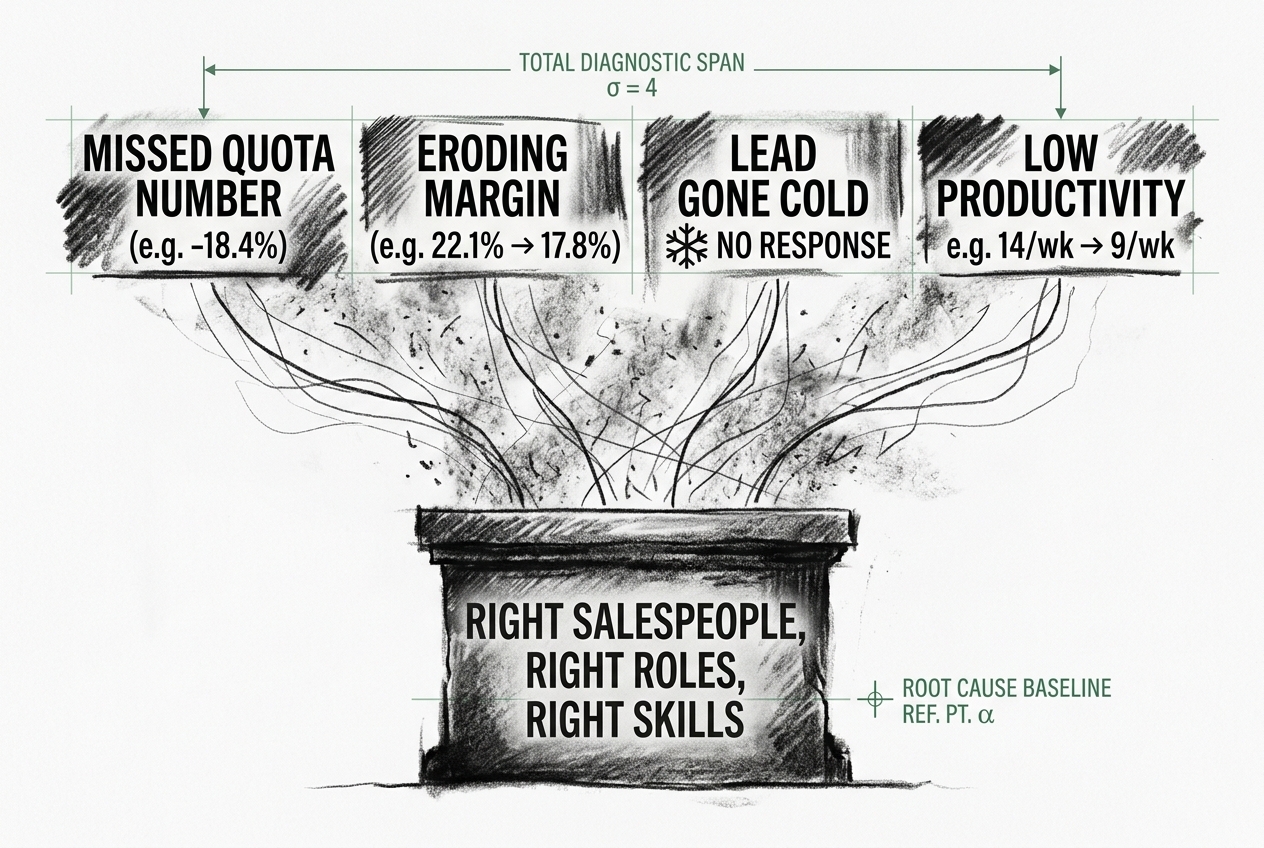
Missed quotas, margin erosion, poor lead follow-up, low productivity: these are symptoms. The evaluation finds the root cause.

Most revenue problems are diagnosed by gut feel. The evaluation replaces that with data.
sales-force-evaluation-symptom-root-cause-diagnostic

When revenue underperforms, leadership tends to react to whatever is most visible: the missed number, the eroding margin, the lead that went cold. But those are symptoms. Treating them one at a time rarely changes the trajectory, because none of them is the actual problem.

The actual problem usually traces back to three questions: do you have the right salespeople, do they have the right skills, and are you adding the right people. A sales force evaluation answers all three with evidence instead of opinion.

  • Decisions made on gut feel and outdated skill profiles
  • People hired because leadership likes them and hopes they can sell
  • A personality test brought in afterward to justify the choice

The trap isn't a lack of effort. It's that the decision gets made on likeability first, then rationalized. The evaluation moves the decision back onto skills and attributes, where it belongs.

What Gets Measured

A modern revenue team is more complex than the old field-rep-to-sales-manager model. The evaluation accounts for every distinct seat.

Sales managers report to VPs. Inside sales may report elsewhere. BDRs may report to marketing. Marketing sells in parallel. Sales force testing has to evaluate each role on its own terms, then aggregate the result into one management overview. Explore each seat below.

The modern revenue function
What the evaluation reads

Whether the leader can build and run the function, including how effective the VP is at coaching sales managers, recruiting the right people, and holding the org accountable. Read as a leadership seat, not a senior rep.

What the evaluation reads

Whether managers actually manage: coaching effectiveness with the team, pipeline rigor, and the ability to develop contributors rather than just report on them.

What the evaluation reads

The skills that move deals (for example, how effective reps are at overcoming objections) alongside prospecting and closing ability. Skills and attributes, not personality.

What the evaluation reads

Evaluated as a distinct revenue role with its own skill profile, not folded into the field model. The evaluation accounts for the motion this seat actually runs.

What the evaluation reads

A revenue-touching seat. The evaluation reads it as its own role rather than assuming it sits outside the revenue function.

What the evaluation reads

Marketing sells in parallel with sales, and BDRs may report into it. The evaluation accounts for marketing as part of the revenue function, not a separate silo.

What gets measured is skills and attributes, not personality or likeability. Sales success can be predicted by data when the methodology accounts for the company, the market, and the products. Each seat is evaluated on its own terms, then aggregated into a single, actionable management overview.

Evaluation vs. Assessment

The two are constantly confused, and they answer two different questions.

One looks at the team you have. The other looks at the people you're considering hiring. Knowing which you need is the first decision.

Evaluation

The team you already have

For a leader who senses something is off with the current team and can't tell what.

An evaluation is run on the current revenue team: Sales VP, sales managers, field sales, inside sales, customer service, and marketing.

It produces an organizational overview of the whole function, plus granular strength-and-weakness detail on each contributor.

  • Diagnoses an existing team
  • Aggregate management view + per-person detail
  • Drives training, coaching, and personnel decisions
Assessment

The people you're considering

For a team that is hiring and wants to stop guessing on candidates.

An assessment is built for recruiting: screening candidates before they're hired.

A license entitles unlimited screenings for a set number of hires, job roles, and duration, so hiring decisions are made on evidence rather than interview impressions.

  • Screens candidates, not current staff
  • Licensed by hires, roles, and duration
  • Predicts fit before the offer goes out
The Two-Layer Output

The evaluation delivers two things at once: a view of the whole function, and a view of every person in it.

One layer is useless without the other. Together they tell you what to fix and who to develop.

Layer 1 · Aggregate

The management overview

A high-level view of the entire revenue function, built so leadership can optimize the whole system, not just react to individuals. It shows where the function is strong, where it's exposed, and where intervention will actually move the number.

Layer 2 · Individual

Strength & weakness detail on every seat

Specific detail on each leader, manager, and contributor: concrete, role-specific, and actionable.

For example: how effective a VP is at coaching sales managers  ·  how effective a rep is at overcoming objections

Team performance
A clear picture of where the function is leaking revenue, so improvement is targeted rather than scattershot.
Tailored training
Development aimed at the specific gaps each person actually has, not generic, one-size training.
Informed personnel decisions
Promotion, restructuring, and exit decisions made on evidence rather than impression.
The Science

The evaluation is built on the OMG engine: sales-specific, and refined and watched since 1992.

Objective Management Group built the original sales assessment. It is sales-specific, not a personality test adapted for sales, and Ed is an OMG-certified STAR.

91%
Predictive accuracy of the OMG sales-specific engine.
92%
of candidates recommended and hired reached the top half of the sales force within six months.
75%
of candidates not recommended but hired anyway failed within six months.
Objective Management Group · since 1992

Sales success can be predicted by data, but only when the methodology accounts for the company, the market, and the products being sold. OMG's evaluations and candidate assessments have been refined and watched against real outcomes for more than three decades.

That is what separates a real evaluation from a personality test with a sales label on it: OMG is sales-specific by design, and the predictive numbers above are the result.

Ed is not a sales trainer.

Ed focuses on strategy, process, and organization, and refers companies to specific sales trainers when training is what's needed. But a necessary precursor to effective training is understanding the current situation. That is where Ed starts.

Common questions
Short answers to what leaders ask before booking a call.
What is a sales force evaluation?

A sales force evaluation is run on a company's current revenue team: Sales VP, sales managers, field sales, inside sales, customer service, and marketing. It measures skills and attributes, produces an organizational overview of the whole function, and adds granular strength-and-weakness detail on each contributor.

What's the difference between an evaluation and an assessment?

An evaluation diagnoses the team you already have. An assessment is for recruiting: screening candidates before they are hired. A license for assessments entitles unlimited screenings for a set number of hires, job roles, and duration.

What does the evaluation actually measure?

Skills and attributes, not personality or likeability. It evaluates each distinct revenue role on its own terms (for example, how effective a VP is at coaching sales managers, or how effective a rep is at overcoming objections) and aggregates the result into one actionable management overview.

How accurate is it?

The evaluation is built on the OMG engine, which is sales-specific and has been refined since 1992, with 91% predictive accuracy. In real outcomes, 92% of candidates recommended and hired reached the top half of the sales force within six months, while 75% of candidates not recommended but hired anyway failed within six months.

Is this sales training?

No. Ed is not a sales trainer. He focuses on strategy, process, and organization, and refers companies to specific trainers when training is what's needed. The evaluation is the necessary first step: understanding the current situation before anything is changed.

Ed Marsh, private equity portfolio growth advisor, in a navy blazer
ABOUT

Three decades inside industrial. Now he measures whether you can sell.

Consultant · Speaker · Director · Author · Veteran

Ed has spent his career inside industrial manufacturing: building, selling, advising, and sitting on boards. He works with lower-middle and middle-market industrial manufacturers and their private equity sponsors to build predictable, scalable organic revenue growth.

The sales force evaluation is the diagnostic at the front of that work. As an OMG-certified STAR, Ed runs the evaluation engine against the realities of industrial revenue teams, and starts every engagement by understanding the current situation before anything is changed.

Johns Hopkins Airborne Ranger National Speakers Association NACD Governance Fellow OMG-Certified STAR Independent Board Director
Primary CTA · No Pitch · No Sequence

Talk to Ed About Your Sales Team

Sharp diagnostic questions. An honest read on whether Ed can help, and if he can't, who can.

An honest read on your sales team.

No pitch deck. No proposal cycle. No follow-up automation. Ed asks sharp diagnostic questions about your organic growth challenge and gives you an honest read on what's actually happening.

  • A clear next step, a better referral, or a few things you can do this week
  • Ed's read on whether your sales problem is people, process, or strategy
  • If Ed isn't the right fit, he'll tell you who is

Ed Marsh, private equity revenue growth advisor, in an open-collar shirt
Ed Marsh
Consultant · Speaker · Director · Author · Veteran
✉ Prefer to leave Ed a message instead? No calendar, no obligation. Ed reads every message personally. ▼

Ed reads every message personally and usually responds within 24 hours.