
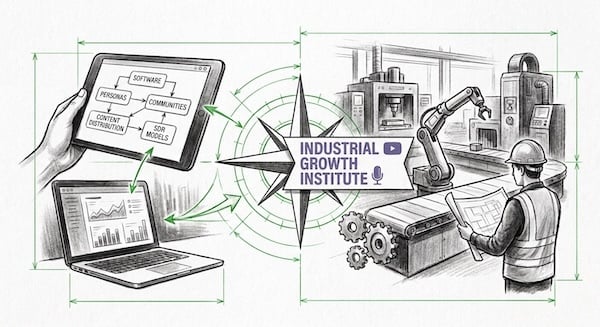
A recap of the Industrial Growth Institute podcast with Brian C. Reed
B2B software has spent twenty years building a cookbook of go-to-market (GTM) recipes: personas, communities, content distribution, SDR models, enablement. Most industrial companies still sell the way they did in 2005. Brian C. Reed, Chief Market Officer at Corsha, has spent decades in software and cybersecurity and now sells into manufacturers, securing the robotics, OT and physical AI on modern production lines. He sits squarely at the intersection, and he makes a blunt case: industrials don't need to invent anything. They need to steal what already works.
TL;DR
- Join the communities your buyers already trust instead of trying to build your own. Starting one is easy. Keeping it alive is brutal.
- Information consumption is fragmented, so your content has to be too. The 20-page white paper is dead; short video, checklists and how-to guides win.
- Stories beat feature lists because the brain is wired to remember them. Walk buyers to the problem before you ever mention the product.
- Marketing and sales are two sides of one coin. Great marketing with bad salespeople still tanks the business.
- Brian's challenge: spend 2-3% more of your capital budget on professional go-to-market and compare the return to your next quarter-million-dollar machine.
Serve the customer, don't sell at them
Brian and Ed met at the Pavilion GTM Summit, where one session stuck with Brian more than the AI talk that dominated the event: Will Guidara on Unreasonable Hospitality.
- The lesson isn't that every company needs to be a three-star restaurant. It's that companies that excel at relationships, with a service mindset, win in the modern market over those that "drive by selling."
- Stop talking about you, your product and your technical specs. Talk about the buyer's problem, the frustration it creates and the outcomes they're missing.
- Nobody wants a hammer. They want the nail in the wall. And "buying your stuff" is a process, not an outcome.
- Often you see what the buyer should want to get done more clearly than they do. Lecturing them won't work. Ask questions and lead them to the realization themselves.
Three buyers you'll find in almost every market
After 30 years across markets, Brian keeps meeting the same three characters:
- Harry the Hair-on-Fire: the pipe burst, the line is down. Who can stop the water, and how fast?
- Paul the Proactive Planner: there's a goal (say, 10 points of OEE improvement) and he's building the multi-step plan to get there through process, technology and training.
- Carla the Compliance Person: there's a mandate (OSHA, an IEC standard) and her job is to get it done, half paperwork and half cajoling.
- Your market may have more, but recognizing which mode the person in front of you is in changes the whole conversation.
- Personas are deliberately simple caricatures. That's the point: they give marketing and sales a shared, empathetic shorthand for people in different mental modes.
Map the communities of influence around your ICP
Brian builds layered Venn diagrams. First, who you sell to (manufacturers of a certain size, product type, equipment base). Then, in parallel, every community that influences those people.
- Communities of influence can be regional peer groups of OT engineers, certification and training bodies (SANS Institute's OT practice), standards communities, role-based groups like Pavilion, individual educators like Mike Holcomb in OT security, or events like ICS Village at DEF CON.
- Overlay the two and ask: which of these do my target companies' people actually participate in or follow?
- Engineers mostly lurk. Low visible activity doesn't mean a community isn't valuable. The easiest way to find the right ones: ask your best customers where they hang out and where they get information.
- Match the community to your buyer's adoption profile. An AI-innovation forum attracts early adopters; your laggard buyers won't go near it.
- Choosing communities is "a lot of dating." Probe, build relationships with the leaders, experience it firsthand. Corsha tried ICS Village this year and signed on to participate going forward.
- Don't build when you can join. At a prior company Brian's team looked at building a DevOps community, found All Day DevOps (which grew to 40-50,000 participants), and jumped in the boat instead. Sponsoring OWASP chapters largely meant buying the pizza and beer.
- The rule once you're in: "Don't ask, give." Provide value and the rising tide lifts your brand.
- Who owns it? Everyone should feel part of a community; some people should be formally attached. Brian has only had a dedicated community manager once. If a team says they don't have time, ask them why they wouldn't spend two hours a month where the exact people they sell to gather.
Fragmented attention needs fragmented content
Ed and Brian both see the SEO-driven content-for-leads model of the mid-2010s as broken. Brian reframes the problem: it's not content, it's information consumption, and that's now massively fragmented.
- Get information in front of buyers through other people's channels: partner newsletters, community distribution, influencers. Corsha brought Mike Holcomb in to speak, share research and run a capture-the-flag at ICS Village.
- Free and useful wins: reports, surveys, toolkits.
- Make it snackable: short video, checklists, how-to guides. Long-form survives where it earns it (benchmark reports people actually want to crawl through).
- Record long-form video, then cut it into short pieces that pull people back to the full version.
- Plant-floor buyers aren't at a laptop clicking ads. But a thin LinkedIn profile doesn't mean they aren't consuming. Be a useful resource there and pull them to your site.
- Reverse engineer how buyers solve problems: call a friend, ask the community, Google, and now the GPTs. Make your content GPT-friendly so AI tools can find it and recommend you.
- Podcasts are a case in point: listened to at 1.5-2x, on commutes, in the background while working. It's become the radio of this business generation.
Storytelling over spec sheets
Brian has a BME/EE degree from Duke. His first startup had two multi-million dollar customers and died anyway, because a room full of engineers had no idea how to sell or market. That's what pushed him to learn the business side.
- For most of human history, stories were how people learned and retained information. The brain is wired for it, and a story attaches far better than "feature ABC, benefit XYZ."
- His OT example: decades of automation brought IT into OT. Criminals learned that ransoming a production line pays far better than ransoming email or ERP, because production goes to zero. Dragos's 2025 OT Cybersecurity Year in Review reported ransomware against industrial organizations rose more than 87% in 2024, with manufacturing accounting for more than half of victims.
- Notice he never gets to the product. The story walks the buyer to the water: "I wonder if we've had that problem?" That opens the next conversation.
- AI helps and hurts. "AI slop" is lazy people using GPTs. Used well, it's a writing companion and ideation partner: better titles, engagement analysis, three angles on a talk. Brian brainstorms by voice with ChatGPT on his commute.
- Always verify any citation AI hands you. It can invent things out of whole cloth.
- Ed's add: in StoryBrand terms, the vendor is the guide and the buyer is the hero. AI can help outline that scenario if you feed it the detail.
Physical AI: the opportunity and the exposure
Physical AI is AI acting in the physical world: driving a robotic arm, inspecting quality optically, judging whether fruit is ripe by touch.
- Expect small, specialized models at the edge, trained on narrow data for one task. "You don't want ChatGPT running your industrial manufacturing plant."
- At the ARM Institute in Pittsburgh, Brian saw a system that tells ripeness by touch, AR goggles (GridRaster) that check weld placement and metal thickness, and optics that inspect an aircraft-engine weld in about two hours versus a week for a master welder.
- An automotive example: today a plant pulls a car or two off the line daily and partially disassembles them for inspection. Optics after each station could make that unnecessary, cut cost, catch defects spot checks miss, and reduce warranty claims.
- He sees it as additive: better quality at a higher rate, even with some staffing adjustment.
- The downside: AI can try more things than traditional automation, so constraints matter. Think of an airlock, where both doors physically can't open at once. What happens when the power goes out? Is the degradation graceful or sudden?
- The race to automate has cross-connected IT, OT and cloud. Attackers phish the IT side and work toward the production line. Physical AI builders have to go the extra mile on safe failure and access control.
How AI is changing sales, and what great sellers look like
- Ed raised sales trainer John Barrows's argument (a past guest, speaking at the same event) that most salespeople are already irrelevant thanks to AI and changing buyer expectations.
- Brian's experience with AI SDRs: when someone fills out a form or describes a problem, a trained AI can respond in a minute with a quality answer. That top-of-funnel responsiveness is real.
- The best salespeople he's seen come from the technical side (empathy for the technologists they sell to) or treat the job as helping someone solve a problem, with a sale along the way.
- He doesn't hire someone because they came from Microsoft or Oracle. He hires empathy for the community being served.
- Interview signals: did you play a team sport or do another team activity? Did you work in hospitality or service? Both tend to identify better performers.
- Marketing or sales? For complex, big-ticket B2B, sales is "the grease in the wheels" for the last mile. But "you can't have a one-sided coin." Great marketing with bad salespeople tanks the business. Bad marketing with great salespeople survives for a while. Greatness in both is where winners happen.
- Specialization (SDR, AE, CS) comes with scale. Early and growth stage is experimentation and finding repeatability. Either way, the board will hold you to the math.
- SDRs measured on 500 dials a day is old school. Measure them on breaking into their top 50-100 accounts while handling inbound.
- Bridging the acumen gap: SDRs can work as the assistant to a company expert ("our CTO asked me to reach out"), engage mid-level team leads, or run a high-low play alongside the CEO working the C-suite.
- A CISO once told Brian: "Stop chasing me. Find the owner of the problem." Ed's counterpoint: capital requests compete and get stack-ranked, so you have to equip that mid-level owner to make the winning argument upstairs.
Building a GTM team from scratch for a mid-market industrial
Ed posed the greenfield question: a middle-market industrial manufacturer, long cycle, complex sale, large buying team, big ticket. Brian's build, sketched on the fly:
- A marketing leader who can build a plan of attack and map the ICP.
- Outsource much of the digital infrastructure early: website, SEO and GEO, design, PR if it matters.
- A demand gen and campaign manager to make the machine run.
- A content creator: product marketing, an industry insider hired as a writer, or the team in aggregate.
- The marketing engine itself: CRM/marketing automation, MOps, website, collateral.
- SDRs, which Brian would put in marketing if they fit your stage.
- One or two field salespeople, one or two sales engineers, and a head of sales.
- Decide early whether you're direct or through VARs, resellers and integrators. If it's a channel model, the next marketing hire may be partner or field marketing, which runs on a different cadence than demand gen.
- He calls it go-to-market enablement, not sales enablement: people, process, technology and content. What's the sales cycle? What are the prospecting questions? Hot lead, trash lead, dry hole? Battle cards? What patterns separate wins from losses? How do you help your buyer take the big request to the boss?
Why tech marketers should look at industrials
- Ed often tells burned-out SaaS marketers they'd be revered in industrial, with longer cycles and less pressure. Few bite, lured by equity and exits.
- Brian thinks it's a great move. Industrial needs quality B2B people to help it modernize, and industrial people should help the newcomers too: tell them what they got wrong, and explain the acronyms.
- Just as B2B steals from B2C, industrial can steal from both.
- And it's physical. You can see, touch and be part of what gets made. Life still runs on making things.
- His forecast: industrial go-to-market can look like B2B SaaS (give or take the physical aspects) in three to five years, if companies move together.
"Go think about what if you spent 2% more or 3% more of whatever your total capital budget is on some professional go-to-market. What could that do to your business? It probably will do more for your business than buying that next quarter-million-dollar piece of equipment."
What this means for you
If you're a PE partner, look at how your portcos allocate capital. Every one of them has a rigorous process for justifying the next machine. Almost none apply that rigor to go-to-market spend, even though the recipes Brian describes are proven, documented and largely free to copy. Because most industrials move slowly, the ones that do adopt them get a differentiation window that won't stay open forever.
If you're an industrial CEO, the question isn't whether tech's playbook applies to you. It's which parts you'll translate first: your ICP and personas, the communities your buyers already trust, content cut for the way engineers actually consume information, and a sales team hired for empathy rather than a logo on the resume.
That's the thinking behind Overall Revenue Effectiveness™ (ORE™): bringing the same rigor to your commercial engine that you already bring to OEE on the shop floor. If Brian's capital-budget challenge made you uncomfortable, that's a good place to start. You can connect with Brian on LinkedIn or learn more about Corsha. The full conversation with Brian C. Reed is on the Industrial Growth Institute podcast.
FAQ
What can industrial companies learn from B2B tech go-to-market?
B2B software has developed a documented set of go-to-market practices, including ideal customer profiles, buyer personas, community engagement, fragmented content distribution, SDR models and go-to-market enablement. According to Brian C. Reed, Chief Market Officer at Corsha, most of these recipes are freely available and can be translated to industrial markets with adjustments for the physical nature of the products.
What are the three common B2B buyer personas?
Brian C. Reed describes three personas found in almost every market: Harry the Hair-on-Fire, who needs an urgent problem solved now; Paul the Proactive Planner, who is executing a longer-term improvement plan such as raising OEE; and Carla the Compliance Person, who must meet a regulatory or standards mandate. Recognizing which mode a buyer is in shapes how sales and marketing should engage.
Should an industrial company build its own customer community?
Usually not as a first move. Starting a community is easy, but building momentum from 10 or 20 members to thousands is very hard. A more effective approach is to identify existing communities where your buyers already participate, such as training bodies, standards groups, peer networks and industry events, and contribute value there rather than asking for business.
How do you find online communities when engineers rarely post?
Engineers often consume information without visibly participating, so low activity doesn't mean a community lacks value. The most reliable method is to ask your best customers which communities they belong to and where they get information. Then test promising communities firsthand and build relationships with their leaders before committing.
What is physical AI in manufacturing?
Physical AI is artificial intelligence that senses or acts in the physical world, such as AI driving a robotic arm, optically inspecting product quality, or assessing fruit ripeness by touch. In manufacturing it typically runs as small, specialized models at the edge. It promises faster, more consistent inspection and quality, but it also raises safety and cybersecurity concerns as IT, OT and cloud systems become interconnected.
How should a mid-market manufacturer structure a new go-to-market team?
Brian C. Reed recommends a marketing leader who maps the ICP and builds the plan, outsourced digital infrastructure (website, SEO, design, PR), a demand generation manager, a content creator, marketing automation, SDRs, one or two field salespeople with sales engineers, and a head of sales. Whether the market is direct or channel-based determines whether partner marketing becomes the next hire.
- Most complex industrial purchases must clear five separate buying decisions.
- Decisions 2 and 3 determine whether a purchase happens at all — and most reps don't know they exist.
- Most big-ticket B2B industrial forecasts are fantasies because they ignore those decisions.
- Buying teams typically include eight to twelve people.
- Reps need business acumen — not just product knowledge — to engage decision-makers early.