
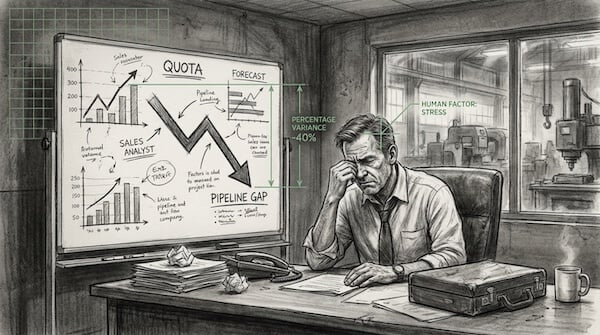
Chronic quota failure is almost never just an individual rep problem. It's a systemic failure. Companies hire for the wrong criteria, provide no sales infrastructure or coaching, and lack a modeled sales funnel, making it impossible to define what "good" performance actually requires.
TL;DR
- When 40 to 60 percent of your industrial sales reps miss quota, you don't only have a personnel problem; you have a system problem. Stop blaming the reps and start examining the system they operate within.
- Hiring is broken. Most companies hire for industry experience and referrals. Both are terrible predictors of success. This approach finds reps who can talk about product specs but can't sell business outcomes to an executive.
- There is no sales infrastructure. New reps are dropped into a vacuum with no inadequate onboarding, poorly defined sales process, no methodology, no playbooks, and clear customized pipeline stages. We wouldn't tolerate this on the factory floor, yet we accept it in sales.
- Sales management is the weakest link. We often promote our best reps into management roles without ever training them to coach, manage a pipeline, or hold people accountable. Weak management guarantees underperformance.
- We don't know our numbers. PE-backed companies with sophisticated financial models rarely apply the same rigor to their sales funnel. Without a model, you don't know the activity and conversion rates required to hit the target, so "quota" is just a guess.
The Excuses Are Plentiful, and They Are Wrong
When I talk to CEOs and private equity sponsors about why so much of their sales team is underperforming, I hear the same things over and over.
"Our reps just aren't hungry enough." "The leads from marketing aren't very good." "It's the economy." "Buyers just aren't making decisions."
And occasionally an honest answer...."We don't know, but we have to fix it!"
These are convenient explanations. They place the blame on individuals or external forces. But after auditing dozens of middle-market industrial companies, I can tell you they are symptoms, not the root cause. The hard truth is that reps are missing quota because the system they work in is fundamentally broken.
It's Not Just a Rep Problem. It's a System Problem.
For a problem this persistent, we have to look past the individuals and at the structure itself. The underperformance is an output of a flawed system. And that system typically fails in four predictable ways.
We Hire for the Wrong Things
The single biggest point of failure is how we hire. Most industrial companies default to two criteria: industry experience and gut feeling. Both feel safe. Both are unreliable predictors of who will succeed in winning new logos in a complex sale.
Hiring for "industry experience" gets you reps who are comfortable talking about products and specs with plant engineers. But complex capital equipment and major MRO contracts are not bought by engineers. They are business decisions approved by leadership, the C-suite or an ownership team that cares about ROI, risk mitigation, and operational efficiency. Your rep who only knows the product can't have that conversation.
This hiring flaw perpetuates a cycle of underperformance. To break it, you need a structured approach that evaluates candidates for the right competencies: business acumen, the ability to build a financial justification, and the discipline to follow a process. Our Sales Talent Hiring & Recruiting service was built specifically to solve this, shifting the focus from who a candidate knows to whether they can actually sell.
We Set Them Up to Fail (Because There's No Infrastructure)
Imagine hiring a skilled machinist and putting them on the shop floor with no CNC machine, no work instructions, and no quality control process. You would never expect them to produce good parts.
Yet, this is exactly what we do in sales.
We hire a new rep and give them a territory, a phone, and a catalog. There's no documented sales process. No agreed-upon sales methodology. No playbooks for common scenarios. No defined pipeline stages with exit criteria. No opportunity qualification scorecards. The new hire is set up to fail from day one because the tools for success don't exist.
We Don't Model the Funnel
Here's an irony I see constantly, especially in PE portfolio companies. The business runs on sophisticated financial models, but the entire sales forecast is based on gut feel and happy ears.
Almost no one has mathematically modeled their sales funnel. They don't know:
- How many outbound activities are required to generate one qualified conversation?
- What is the conversion rate from a qualified conversation to a formal proposal?
- What is the win rate on proposed deals?
- What is the average deal velocity from first contact to close?
Without this data, the "quota" is just a number pulled from a spreadsheet. It has no connection to the real-world activity required to achieve it. You can't define what "good" looks like for a rep because you haven't quantified the work. And you can't identify specific areas for training and coaching focus.
We Promote Our Best Reps into Our Worst Managers
The sales manager is the most critical role for revenue growth, and it is almost always the weakest. The typical path is to take your top-performing rep and make them a manager, with zero training on how to actually manage.
Carrying a bag and coaching a team are completely different skills. A great rep who is now a manager doesn't know how to run a pipeline review, coach a deal, or hold an underperformer accountable. Instead, they often become "super reps" who jump in to save deals, teaching their team nothing in the process. This lack of coaching and accountability is a primary driver of chronic quota miss.
The Operational Double Standard Most Boards Miss
Here is a simple question for any leader at a manufacturing company: Would you accept a 40% defect rate on your primary production line?
Of course not. You'd have teams of engineers swarming the problem. You would implement Six Sigma, Lean, or whatever methodology was required to fix the process. You would measure everything. You would never tolerate that level of failure.
And yet, we routinely accept that 40 to 60 percent of our sales reps, the people who drive the entire revenue engine, will fail to do their jobs. We treat a systemic business failure as a series of individual shortcomings. This is a massive failure of leadership and governance.
The Cost of Getting it Wrong is an Entire Value Creation Cycle
For a private equity sponsor operating on a five to seven year hold period, this isn't just an operational headache. It's an existential threat to the investment thesis because it cripples the organic growth component of value creation.
The pattern is tragically predictable. A porto hires a new VP of Sales based on a referral. That leader fails to build the necessary infrastructure and misses targets. Eighteen to 24 months later, they're replaced. The board, using the same flawed hiring criteria, hires another one. Another two years are burned.
Two or three of these cycles can consume the entire value creation timeline, leaving the firm with a flat-growth asset that missed the plan. Getting the revenue growth leadership and team structure right from the beginning is not optional. It is the prerequisite for hitting the organic growth trajectory reflected on bridge slide, and firms like Ed Marsh Consulting are often engaged to de-risk that specific part of the value creation plan.
Chronic quota failure isn't bad luck. It's the predictable result of a broken system. Fixing it requires leaders to stop tweaking and start applying the same process discipline to their revenue engine that they have always applied to their operations.
Frequently Asked Questions
Why do 40 to 60 percent of industrial sales reps miss quota?
Chronic quota failure is a systemic issue rather than an individual rep problem. It results from hiring for the wrong criteria, lack of sales infrastructure, weak management, and failing to model the sales funnel effectively.
What is wrong with the current hiring practices for industrial sales reps?
Companies often hire based on industry experience and referrals, which do not predict success in sales. To succeed, candidates need competencies such as business acumen, financial justification building, and process discipline.
How does the lack of sales infrastructure impact new sales reps?
New sales reps are frequently given no defined sales process, methodology, or tools, leading them to be set up for failure from their first day on the job.
Why is sales management often considered the weakest link?
Top-performing reps are often promoted to management without proper training in necessary management skills, resulting in poor pipeline review, deal coaching, and accountability.
- Most complex industrial purchases must clear five separate buying decisions.
- Decisions 2 and 3 determine whether a purchase happens at all — and most reps don't know they exist.
- Most big-ticket B2B industrial forecasts are fantasies because they ignore those decisions.
- Buying teams typically include eight to twelve people.
- Reps need business acumen — not just product knowledge — to engage decision-makers early.