
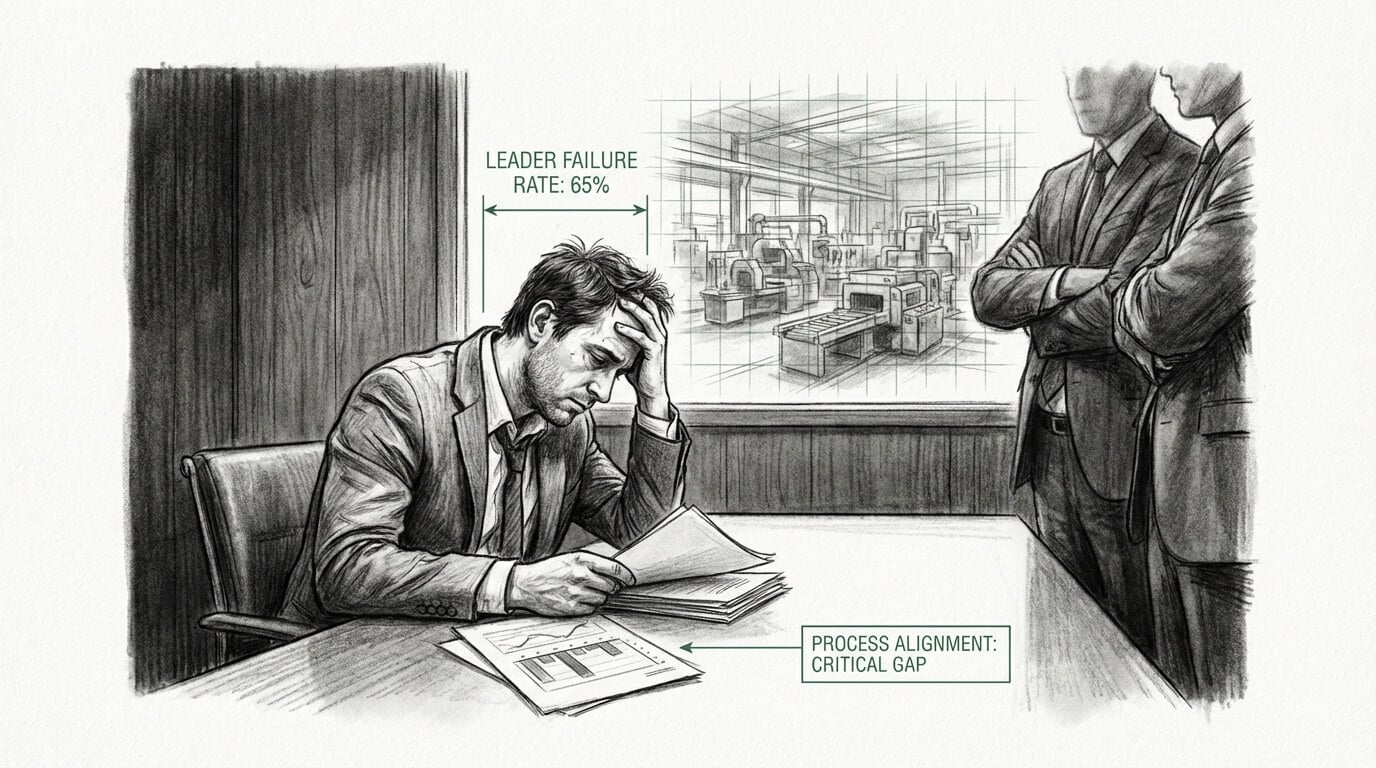
New sales leaders fail because industrial companies consistently hire for the wrong criteria. They select for industry experience and a pre-existing rolodex, overlooking the one thing that actually matters: sales management competence and the ability to build a modern revenue engine. The hire is then often dropped into a virtual vacuum with inadequate or missing sales process, a limited accountability structure, and a board that lacks contemporary revenue growth oversight perspectives. The result is a predictable 18 to 24-month churn cycle that stalls EBITDA growth, impairs target IRR, and burns valuable time.
TL;DR
- Most new industrial sales leaders are hired for industry experience, not for their ability to build sales infrastructure (process, methodology, playbooks) or manage a team. This is the foundational mistake.
- They walk into an environment with high expectations, but systemic shortcomings. The company often has no defined sales process, weak pipeline management, poor opportunity qualification, and a culture of low accountability. The effort is destined to struggle from day one, but folks don't realize it, and when it becomes apparent can't diagnose why.
- The hiring criteria are misaligned with the actual job. The role requires building a system, but companies hire people who excelled at operating within an outdated one.
- For private equity-backed companies, each failed two-year cycle consumes a material portion of the five-to-seven year hold period, putting the entire value creation plan at risk. The problem isn't a bad hire; it's an inadequate system of people and process.
The Two-Year Churn Cycle: A Pattern We Refuse to See
You’ve seen this movie before. A PE sponsor acquires a middle-market manufacturer with a solid product but nominal growth. The investment thesis hinges on faster growth through new logo acquisition. It's a huge piece of the value creation plan, and so often a new VP of Sales is a high profile initial hire.
The board taps its network, finds a candidate with 20 years of experience selling a similar product, and makes the hire. The first six months are a "listening tour." The next six are spent complaining about the team they inherited, quoting process, unpredictable buyers, etc. At 18 months, the pipeline is still a mess, the forecast is fiction, and new logo growth is stagnant. Around the 24-month mark, the company "makes a change."
Then they run the exact same play again, hiring another candidate with deep industry experience. And they get the exact same result.
This isn't a series of unfortunate, isolated events. It's a pattern. It's a systemic failure rooted in a profound misunderstanding of what drives revenue growth in the modern industrial market.
What We Think Is the Problem (And Why We're Wrong)
When a new sales leader fails, leadership and the board typically attribute it to a handful of convenient excuses:
- "It was just a bad hire."
- "The market turned against us."
- "The territory was tougher than we thought."
- "(S)he just didn't have the right relationships."
But these are symptoms, not the disease. The real failure isn't merely individual; it’s in the system that selected them and the environment. The failure was predictable from their first day.
The Real Reasons Your New Sales Leader Will Likely Fail
The two-year churn cycle is predictable because the underlying conditions are nearly universal across the industrial middle market. A new leader, regardless of talent, is often overwhelmed by deeply entrenched, systemic problems they were neither hired for nor equipped to solve.
We Hire for Industry Experience, Not Management Competence
This is the original sin of industrial sales hiring. We default to hiring people who know our products and our market. We believe their existing relationships and command of industry lingo and technology will translate into new business.
This is a flawed premise. In complex industrial sales, buyers don't buy from a rolodex; they buy a business outcome. A candidate who has spent 20 years having product-and-spec conversations with plant engineers often lacks the business acumen to hold a value-based conversation with a CFO. They can "find projects" that are already in motion, but they don't know how to "create projects" by engaging executives early to shape their buying vision - much less train their team to do so. More importantly, they were never trained to build a substantive sales process, coach reps, or instill accountability. They were a successful rep, and perhaps an adequate manager in a very different market environment.
They Walk into an Infrastructure Vacuum
A manufacturer that would never tolerate a 40% defect rate on the production floor somehow accepts that 40 to 60% of its sales reps chronically miss quota. This isn't a only rep problem; it's a management and process problem.
The new sales leader walks into a company with:
- Poorly defined sales process: Reps do whatever they want, however they want.
- No sales methodology: There is no common language or framework for qualifying opportunities or advancing deals.
- Inadequate pipeline stages with exit criteria: A deal's stage is based on a rep's gut feeling, rendering the forecast useless.
- Missing pre and post-call planning/debriefs, or opportunity scorecards: Every sales call is an improvisation.
- No real coaching: Sales "management" is a weekly pipeline interrogation, not a skills development function.
We hire a leader and expect them to hit a number without understanding that they need to build the entire revenue engine - often from scratch. It is an impossible task.
The Board Lacks Contemporary Revenue Growth Oversight
In many PE-backed and family-owned companies, the board's experience is in finance, operations, or engineering. They have very little contemporary revenue growth experience. They don't know the right questions to ask.
Their oversight focuses on lagging indicators like bookings and the total size of the pipeline. They rarely have the insight to question the quality of that pipeline. They don't ask about deal velocity, conversion rates by stage, or the percentage of non-participating pipeline (deals that haven't advanced in 90 days). This means a failing sales leader can present a big, impressive-looking pipeline for months before the board realizes it's essentially a mirrage.
We Haven't Defined What "Good" Looks Like
For all their financial and modeling sophistication, most PE-backed industrial companies have never mathematically modeled their sales funnel. They don't know what the team actually needs to do at the top of the funnel (activity levels) and through the middle (conversion rates) to hit the revenue target at the bottom.
Without this model, you can't define what "good" looks like in a sales hire. You don't know if you need a leader who can build a high-volume, transactional process or a low-volume, highly consultative one. You're hiring for a role whose performance requirements have not been quantified.
Breaking the Cycle: A Different Approach to Sales Leadership
If you want a different outcome, you need a different approach. Continuing to hire based on industry experience is an abdication of leadership. It’s choosing the comfortable, familiar path that you already know leads to failure.
Stop Hiring for a Rolodex, Start Hiring for a Playbook
The next sales leader you hire shouldn't be the one who knows everyone in the industry. It should be the one who can build a scalable, repeatable system to generate revenue. You're not hiring a super-rep; you're hiring an architect for your revenue engine.
The critical question is not "Who do you know?" It's "Show me the sales process you built and managed in your last role. Show me your sales playbook. Show me your manager's coaching cadence. Show me how you model a sales funnel."
Diagnose the System Before You Hire the Person
The most effective way to break the churn cycle is to fix the underlying system first or, at a minimum, hire a leader with the explicit mandate and qualifications to build it. This requires a structured process that evaluates candidates against the right criteria. A service like my Sales Talent Hiring & Recruiting is designed specifically for this. It moves beyond the flawed "industry experience" filter to assess the competencies that actually predict success.
An effective evaluation process must determine if a candidate can:
- Sell business outcomes to executive buyers, not just product features to technical users.
- Build sales infrastructure (process, methodology, playbooks), not just operate within existing systems.
- Instill a culture of prospecting to "create projects," not just "find projects."
- Demonstrate the management competence to recruit, hire, coach, develop, and hold a sales team accountable.
Protecting the value creation timeline for a portfolio company or ensuring a successful transition for a family-owned business starts with recognizing that sales hiring is not an HR function. It is a strategic imperative that requires the same rigor and process discipline as manufacturing.
The Real Cost of Getting it Wrong (Again)
For a PE firm operating on a five to seven-year hold period, a single failed sales leadership hire who burns 24 months is a disaster. Two of them can render the IRR target unattainable. The opportunity cost isn't just the leader's salary; it's two years of stalled growth, two years of market share lost to competitors, and two years closer to an exit with a missed plan.
The problem of failing sales leaders is not unsolvable. It simply requires leaders and boards to stop treating sales as an art form driven by relationships and start treating it like the engineered process it must become. Stop blaming the hire. Look at the system that hired them and the environment you asked them to work in. Then use predictively accurate, empirical data to quantify their skills.
That is a leadership responsibility.
Frequently Asked Questions
Why do new sales leaders fail at industrial manufacturers?
New sales leaders fail because companies focus on hiring for industry experience and existing networks, instead of management competence and the ability to build a modern revenue engine. They are placed into environments lacking a structured sales process, accountability, and effective board oversight.
What is the role of hiring criteria in the failure of sales leaders?
Companies often misalign hiring criteria with the actual demands of the job. They hire for industry experience, expecting leaders who know how to operate within an existing system when they actually need someone who can create and implement a sales infrastructure, train sales reps and maintain accountability.
How can companies improve their sales leadership hiring process?
To improve the hiring process, companies should stop prioritizing industry experience and instead seek candidates who can build scalable and repeatable systems for generating revenue. The focus should be on those who can establish a playbook, develop a sales process, and manage a team effectively. The hiring system should incorporate data and a refined, repeatable process.
What systemic problems do new sales leaders face?
New sales leaders face systemic issues such as lack of a defined sales process, inadequate sales methodology, absence of pipeline management with clear exit criteria, mediocre sales talent, and poor board oversight, which hamstring their ability to drive company growth effectively.
- Most complex industrial purchases must clear five separate buying decisions.
- Decisions 2 and 3 determine whether a purchase happens at all — and most reps don't know they exist.
- Most big-ticket B2B industrial forecasts are fantasies because they ignore those decisions.
- Buying teams typically include eight to twelve people.
- Reps need business acumen — not just product knowledge — to engage decision-makers early.