
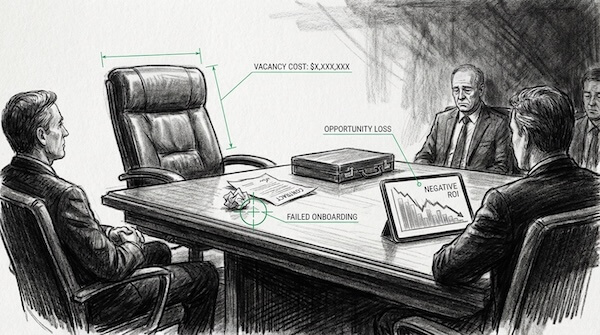
A failed sales leader hire costs an industrial company 18 to 24 months of stalled revenue growth. For private equity portfolio companies on a five-to-seven-year hold, two of these failed hires can consume nearly half the value creation timeline before the real work of growing the business even begins. And they represent enormous direct, and indirect (opportunity) cost.
TL;DR
- The Conventional Math is Wrong: Most companies calculate the cost as salary plus recruiting fees and severance. This misses the real damage by an order of magnitude.
- The True Cost is Time: The biggest cost is the 18 to 24 months of opportunity cost. During this period, revenue growth stalls, the sales team languishes without effective management, and the company falls further behind its value creation plan.
- Systemic Damage Adds Up: Beyond the timeline, a bad hire corrupts the sales pipeline with unqualified deals, drives away your best reps, erodes leadership's credibility with the board, and reinforces a broken sales culture.
- The Root Cause is a Broken Process: These failures are not bad luck. They are the predictable result of hiring based on the wrong criteria, typically industry experience and personal referrals, instead of proven management competence and the ability to build sales infrastructure.
We Keep Getting the Math Wrong
Ask a CFO or a PE operating partner about the cost of a bad sales hire, and you’ll likely get a spreadsheet-ready answer. It usually includes the leader’s salary, any bonuses paid, the recruiting fee, and severance. It’s a clean, quantifiable number.
And it is dangerously wrong.
It’s wrong because it treats a strategic failure like a line-item expense. A manufacturer that applies Six Sigma rigor to its production floor, tracking defects per million with obsessive precision, somehow accepts a gut-feel, hope-as-a-strategy approach to building its revenue engine.
We tolerate a 40 to 60% defect rate in sales (reps chronically missing quota) that we would never accept in operations. The cost of a bad hire isn't an accounting entry. It’s a two-year anchor dropped on your growth plan.
The Two-Year Black Hole of a Failed Sales Leader
The real cost isn't the money you spend on the person. It’s the revenue you don’t generate while they’re in the seat, and the time you can never get back.
The pattern is remarkably consistent in the middle-market industrial companies we see.
A new sales rep is hired, often based on a great resume from a large competitor or a referral from a board member. They arrive, but the promised growth doesn't. They can’t implement a sales process because they’ve never had to build one. They can’t coach reps because their only skill was carrying their own bag. They can’t build a qualified pipeline because they don't know how to instill the discipline of prospecting to "create projects" rather than just "find projects."
It takes about six months for the organization to realize things aren’t improving. It takes another six to twelve months of performance plans and board frustration before a change is made. Then, it takes another three to six months to find and onboard a replacement.
You just burned 18 to 24 months.
For a PE-backed company with a five-year hold period, you’ve just lost nearly half of your value creation timeline. Repeat that mistake once, and the entire investment thesis is at risk. That is the real cost.
The Downstream Damage You Can't Put in a Spreadsheet
Beyond the massive opportunity cost, a bad sale hire inflicts deep, systemic damage on the organization. The effects linger long after the person is gone.
- Your Pipeline Becomes a Liability. Without a disciplined process and qualification criteria, the pipeline fills with unqualified deals. The forecast becomes a work of fiction. This makes it impossible for leadership to make sound business decisions and completely erodes the board's confidence in the revenue team.
- Your A-Players Leave. High-performing sales reps crave competent leadership, coaching, and a process that helps them win. When they don’t get it, they leave. A bad hire doesn’t just fail to attract new talent; they actively drive your best talent away.
- Your Culture Rots. The bad hire often inherits a team where 40% of reps are chronically underperforming. Without a management system to enforce accountability, this mediocrity becomes entrenched. The new leader fails to implement change, reinforcing the team’s belief that process and rigor don’t matter.
- Your Strategic Position Weakens. The market doesn’t wait while you fix your internal problems. While your team is busy chasing unqualified RFPs and maintaining existing accounts (where 70% of revenue typically comes from), your competitors are out creating new projects and shaping the buying vision of your prospects. You’re not just standing still; you’re actively losing ground.
Why This Cycle Repeats: The Root Cause is a Flawed Hiring System
Companies repeat this painful two-year cycle because they are solving the wrong problem. They think they have a "people" problem when they actually have a "process" problem.
The entire hiring methodology is broken. It’s based on two criteria that are terrible predictors of success in modern industrial sales:
- Industry Experience: This usually means they know the products and have a Rolodex. It almost never means they have the business acumen to sell outcomes to an executive buyer or the management skills to build a scalable sales engine.
- Referrals: Someone on the board or in their network "knows a guy." This gut-feel approach bypasses any rigorous evaluation of the competencies that actually matter.
This is precisely why Ed Marsh Consulting developed its Sales Talent Hiring & Recruiting service. The goal isn’t just to fill a seat. It's to break the cycle by installing a disciplined, repeatable system that evaluates candidates for the right things: their ability to build process, their competence in coaching a team, and their skill at selling business outcomes, not just product specs.
Breaking the Cycle: Applying Engineering Discipline to Hiring
To stop the cycle of failed hires, you must fundamentally change what you look for. Stop hiring for who they know and start hiring for what they can do and, more importantly, what they can build.
Your evaluation process must be redesigned to find leaders who can:
- Build Infrastructure from Scratch. Most middle-market industrial companies have no real sales infrastructure for a new hire to plug into. You need to hire someone who can build the onboarding, process, the methodology, the playbooks, and the accountability frameworks, not just operate inside a pre-existing system.
- Sell Business Outcomes, Not Product Features. Your reps are comfortable talking to plant engineers about specs. But the real decision-makers, the C-suite and owners, buy business outcomes like increased throughput, reduced risk, or improved profitability. You need a leader who can hold that conversation and teach a team to do the same.
- Model the Funnel. A company with PE-level financial sophistication should never lack a mathematical model of its sales funnel. A great sales leader can help you build one, defining the specific activity levels, conversion rates, and deal velocity required to hit the revenue target. Only then can you hire reps who actually fit the model.
- Coach and Develop Talent. The most important role of a sales manager is to make their people better through accountability and coaching. You must rigorously evaluate a candidate's history of coaching reps, managing them with data, and creating a culture of continuous improvement.
Instituting this level of rigor isn’t easy, especially when you’re also trying to hit a quarterly number. It is a leadership function that requires a dedicated, disciplined focus.
This is not a problem that tweaks can fix. It is a systemic failure that requires a fundamental change in how you view the entire revenue function. It's time to treat the building of your sales engine with the same engineering discipline you apply to every other part of your business. This is a leadership decision, and the time to make it is now.
Frequently Asked Questions
What is the main cost of a bad sales hire in a manufacturing company?
The main cost is the 18 to 24 months of stalled revenue growth, which acts as an opportunity cost where the company falls behind its value creation plan.
How does a bad sales hire affect the sales pipeline?
A bad sales hire results in a pipeline filled with unqualified deals, eroding leadership credibility and making effective business decision-making impossible.
What are the systemic damages caused by a failed sales hire?
Systemic damages include driving away top talent, corrupting the sales culture, undermining strategic market position, and causing decision-making paralysis due to misplaced opportunities in the sales pipeline.
What hiring criteria are often wrongly prioritized for sales leaders?
Companies often wrongly prioritize industry experience and personal referrals, which do not predict success in building a sales infrastructure or managing teams effectively.
- Most complex industrial purchases must clear five separate buying decisions.
- Decisions 2 and 3 determine whether a purchase happens at all — and most reps don't know they exist.
- Most big-ticket B2B industrial forecasts are fantasies because they ignore those decisions.
- Buying teams typically include eight to twelve people.
- Reps need business acumen — not just product knowledge — to engage decision-makers early.