
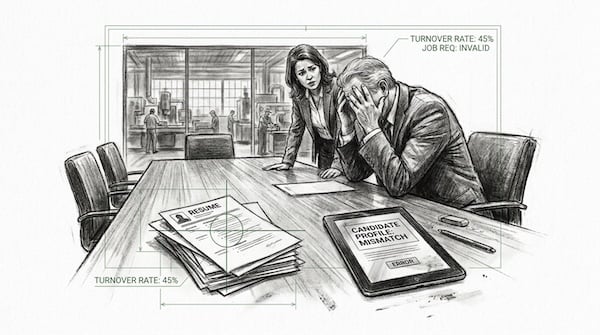
The biggest mistakes are overvaluing industry experience, ignoring a candidate’s ability to follow a sales process and sell consultatively, and failing to test for the business acumen required to sell to the C-suite. This leads to predictable underperformance and costly turnover.
TL;DR
- The single biggest mistake is prioritizing industry experience over sales process discipline. This often brings in candidates with outdated habits who can't build or operate a modern sales engine. It overlooks accountability and excuse making, and often results in retreads who hop companies every few years.
- Companies lack a structured, repeatable hiring process, relying instead on "gut feel" and referrals, which are unreliable predictors of success in complex sales.
- Hiring managers fail to assess if a candidate can sell business outcomes to executives, not just talk product features with engineers.
- They often promote top-performing reps into management, confusing sales ability with coaching and management competence.
- Ultimately, firms ignore the systemic issues (no sales process, weak management and coaching, no accountability) that set even a potentially good hire up to fail.
The Deceptive Allure of the "Industry Veteran"
Ask any leader at a middle-market manufacturer what they look for in a new sales hire, and you’ll hear the same answer: "We need someone who knows the industry. Someone with a rolodex."
It’s the conventional wisdom. It’s also deeply wrong.
This belief is the single most destructive mistake in industrial sales hiring. When you hire for industry experience, you're not getting a head start. You're often inheriting a set of well-marinated, outdated habits. You get someone who knows how to have comfortable product conversations with plant engineers but lacks the business acumen to hold a credible conversation with the C-suite, where the real project decisions are made.
They are experts at prospecting to "find projects" that are already active. But by then, the game is largely lost. Research consistently shows that a short list of vendors is built long before a buyer ever speaks to a rep. Playing catch-up on active RFPs is not a growth strategy; it's a recipe for low win rates and compressed margins.
This hiring philosophy is why 70% of revenue at so many industrial companies comes from repeat customers. The sales team is optimized for account maintenance, not new logo acquisition. For a private equity sponsor whose value creation plan depends on new logo organic growth, this is a fatal flaw baked right into the hiring criteria.
You're Hiring a Part for an Engine That Doesn't Exist
Here’s the second mistake, and it’s a symptom of the first. Most middle-market industrial companies have no real sales infrastructure. No defined sales process. No sales methodology. No playbooks. No meaningful pipeline stages with exit criteria.
They apply Six Sigma, 5S, and incredible process rigor to their factory floor but run their revenue function on gut feel and intuition. A 40% defect rate on the production line would get the Andon Cord pulled. Yet, a 40 to 60% chronic quota miss-rate from the sales team is accepted as the cost of doing business.
When you hire a new rep or leader and drop them into this vacuum, you set them up to fail. You're hiring a gear for an engine that hasn't been built.
A great sales leader isn't just someone who can sell. They are an architect who can build the sales process, coaching cadence, and accountability framework from scratch. A great rep isn't just someone with relationships. They are an operator who can execute a defined process with discipline.
Hiring for "industry experience" almost never gets you this. It gets you someone who spent three years inside another company's system, but it likely wasn't solid, and even if it was, they have no idea how to construct one themselves.
Why Your "Proven" Sales Leader Fails Every 18 Months
For PE-backed portfolio companies, this systemic failure manifests in a predictable and disastrous cycle. A new sales leader is hired based on a great resume from a large competitor and ability to participate appropriately in board meetings. They arrive, find no process to manage, and lack the skills to build one. They can't coach effectively. The pipeline remains a mess of unqualified opportunities. The forecast is a fantasy.
After 18 to 24 months of stalled results and broken promises, the company makes a change. And what criteria do they use for the next hire? Industry experience and a good network. The cycle repeats.
Two of these cycles can consume four years of a five-to-seven-year hold period, completely torpedoing the value creation plan. This isn't a people problem; it's a process problem that starts with hiring. It's why a structured Sales Talent Hiring & Recruiting process is so critical. It moves beyond the resume to evaluate a candidate's actual competence in building and running a modern revenue engine, directly protecting the investment thesis.
The Questions Your Board (and CEO) Should Be Asking, But Aren't
This cycle persists because of a governance gap. Most boards have deep operational and financial experience, but they lack contemporary revenue growth expertise. They don't know the right probing questions to ask of a new sales leader candidate or their current one.
They ask about the size of the pipeline, not the methodology used to qualify it. They ask about target markets, not the sales funnel model that dictates the activity required to win in those markets.
Here are the questions that actually matter in an interview:
- "Walk me through the specific, stage-based sales process you personally built and implemented at your last company."
- "How do you distinguish between prospecting to 'find projects' and a strategy to 'create projects'?"
- "Describe your weekly coaching framework with your reps. How do you use it to move deals forward and develop skills?"
- "Show me how you would build a sales funnel model to determine the precise activity levels our team needs to hit its revenue target."
Most candidates hired on "industry experience" cannot answer these questions. I find that asking them is the fastest way to separate true revenue engine builders from career bag-carriers who just look good on paper.
Stop Hiring for a Resume. Start Hiring for Competency.
The path to predictable revenue growth begins with changing how you hire. Stop prioritizing the resume and start evaluating for the core competencies that actually drive success in complex industrial sales.
These competencies are not industry-specific. They are universal.
- Process Discipline: Can the candidate build, implement, and, most importantly, follow a structured sales process with rigor?
- Business Acumen: Can they lead a credible conversation about business outcomes, ROI, and risk with an owner or executive team?
- Coaching Ability (for leaders): Do they have a proven framework for developing talent and holding a team accountable to KPIs, or are they just a "super rep" who will inevitably micromanage?
- Prospecting Philosophy: Do they understand how to engage buyers early in their journey to shape the buying vision, or will they spend their time chasing deals they are statistically destined to lose?
Hiring is the first and most critical process in your entire revenue engine. Treating it with any less rigor than you treat your production line is a fundamental leadership failure.
Frequently Asked Questions
What is the biggest mistake in sales hiring for middle-market manufacturing companies?
The biggest mistake is prioritizing industry experience over sales process discipline, leading to underperformance and turnover.
Why is hiring for industry experience often detrimental?
Hiring for industry experience brings outdated habits and lacks the business acumen required to engage the C-suite, leading to high repeat customer rates but failing to acquire new logos.
What issues arise from lacking a structured sales process?
Without a structured sales process, companies experience high quota miss-rates, and new hires are set up to fail as there's no existing system for executing a sales strategy.
How can companies improve their sales hiring process?
Companies should focus on evaluating core competencies like process discipline, business acumen, and coaching ability instead of relying solely on industry experience.
- Most complex industrial purchases must clear five separate buying decisions.
- Decisions 2 and 3 determine whether a purchase happens at all — and most reps don't know they exist.
- Most big-ticket B2B industrial forecasts are fantasies because they ignore those decisions.
- Buying teams typically include eight to twelve people.
- Reps need business acumen — not just product knowledge — to engage decision-makers early.