
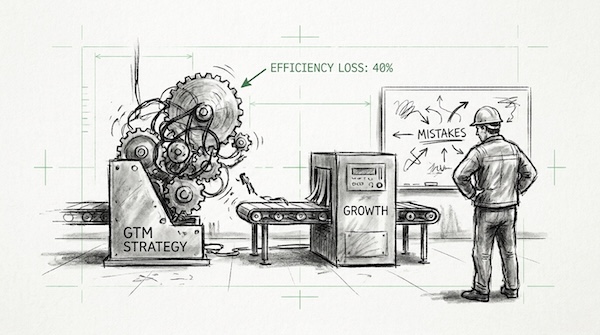
The most common go-to-market mistakes industrial manufacturers make are systemic, not tactical. They reflect assumptions from last decade and ignore the context of industrial growth in a Zero TRUST and Zero CLICK world. They include marketing about us (instead of buyers' aspirations), hiring for industry experience over sales competence, mistaking account management for new business development, misunderstanding demand generation in a post COVID and AI world, and failing to apply operational rigor to the revenue function. These issues lead to stalled growth and reduced valuation.
TL;DR
Common GTM failures in industrial companies are symptoms of a broken underlying system. These aren't minor missteps; they are structural flaws that cap growth potential, particularly for PE-backed firms with a defined value creation timeline and a thesis dependent on organic growth. The most frequent mistakes include:
- Hiring the Wrong Profile: Prioritizing deep industry and product knowledge over the core competencies required to sell complex business outcomes to executive buyers. This perpetuates a cycle of hiring reps and leaders who can't build or execute a modern GTM strategy.
- Marketing to Ourselves: Companies perversely commoditize themselves and their solutions through efforts to differentiate themselves. Incessant promotion of what they make and do ignore the outcomes and aspirations that actually drive buyers to action, and make them sound identical to every competitor.
- Confusing Farming with Hunting: Celebrating high repeat-customer revenue (often 70% or more) as a sign of loyalty when it actually signals a sales team optimized for account maintenance, not the new logo acquisition required for organic growth.
- Lacking a Sales Infrastructure: Operating without a defined sales process, methodology, or pipeline stages. This makes revenue unpredictable, forecasting a guessing game, and coaching nearly impossible.
- Conflating Demand with Traffic: SEO, content, forms and inbound leads were powerful. Until they weren't. Today's buyers don't search for a vendor; they juggle priorities, absorb information, constantly calibrate authority and trustworthiness, and ask AI to help them understand problems, compare solutions, and suggest alternatives. It's a completely different context.
- "Finding" Instead of "Creating" Projects: Relying on a prospecting model that focuses on finding active projects or RFPs. By this point, the buyer has already done their research and the vendor is often just column fodder.
- Applying Zero Process Discipline: Tolerating a 40 to 60% quota miss rate in the sales department, a defect rate that would be unthinkable on the manufacturing floor. This reflects a cultural failure to treat revenue growth as a process to be engineered, not an art form.
Mistake #1: We Hire for Industry Experience, Not Sales Competence
This is the original sin of industrial sales. We default to hiring reps and sales leaders based on two criteria: they come from our industry (or a competitor), and they have a good network. Both are unreliable predictors of success.
This approach creates a sales team that is well-marinated in its own perspective. They know the products and the specs. They can have a great conversation with a plant engineer. But can they build a business case for a CFO? Can they navigate a complex, multi-stakeholder buying committee? Usually not.
The problem is that complex industrial purchases are project-level decisions made by executive leadership, not product-level decisions made by technical users. Hiring exclusively for industry experience often leads to stalled growth and failed hires.
Breaking this cycle requires a fundamentally different approach, one that evaluates candidates against the specific competencies needed to build infrastructure and drive new business. This is the entire premise behind Ed Marsh Consulting's Sales Talent Hiring & Recruiting service, which installs a structured, repeatable process to identify, evaluate, and hire talent that can actually move the needle on organic growth, protecting the value creation timeline.
Mistake #2: Nobody Cares About What We Make and Do
Marketing focuses relentlessly on repeating messages around our technical features, unique capabilities and exceptional quality and service. In doing so, it sounds identical to every competitor. This costs us in two ways.
First, in a Zero Trust, Zero Click world, we hemorrhage credibility by sounding like everyone else. Why would someone trust us when it's clear our claims are exaggerations and narratives? Second, we fail to speak to what matters to buyers - their unspoken, deep angst that they are reacting but unclear on how to regain control and improve their condition.
Mistake #3: Our "Sales" Team Is Really an Account Management Team
Walk into most middle-market industrial manufacturers and you'll find this pattern: 70% or more of annual revenue comes from existing customers. Leadership often celebrates this as a sign of customer loyalty.
It is, but is that an annalloyed good? Typically it’s a sign of a sales organization that is incapable of acquiring new logos - a shortcoming that has become normalized. The skills, mindset, and activities required for this differ markedly from those required to maintain existing accounts. This focus on maintaining rather than acquiring new accounts inhibits organic growth.
Mistake #4: We Demand Rigor in Operations but Tolerate Chaos in Sales
The hypocrisy is stunning. A manufacturer that uses Six Sigma to drive defects on the production floor down to near zero will somehow accept that 40 to 60% of its sales reps chronically miss their quota.
Imagine a plant manager telling the CEO, "Well, about half our production lines just aren't hitting their numbers, but we hope they'll do better next quarter." They would be fired on the spot. Yet, this is standard operating procedure in sales.
This happens because most industrial companies don't view sales as a process to be engineered. They see it as an art, dependent on individual heroics and relationships. This tolerance for quota miss rates leads to unpredictable revenue and poor forecasting.
Mistake #5: Marketing Activity ≈ Revenue Precursors
We came tantalizingly close to a world in which we could attribute every dollar of revenue to a specific dollar of marketing spend. That was more like the path of a comet that nears the body it orbits, just as it heads off into space.
We need to understand how buyers consume information, how brand and trust are built, how buyers are educated, how we build credibility and authority, and how we support exceptional, right-tail sales talent in their efforts to enter accounts and create projects.
Mistake #6: We Prospect to "Find Projects," Not "Create Projects"
This is a subtle but critical distinction. Most industrial prospecting is focused on uncovering active projects. Reps are taught to ask questions like, "Do you have anything coming up?" or "Are you sending anything out to bid?"
Here’s the problem with that approach: Data shows that in a complex B2B sale, the buyer is often 70% of the way through their decision-making process before they ever speak to a sales rep. The short list is already built. The specs are likely written around a preferred vendor. In fact, ≈80% of the time the first vendor contacted wins the order.
When your reps are prospecting to "find projects," they end up competing on price and playing a losing game. Great sales reps, however, prospect to "create projects." They engage potential buyers early, educating and shaping their vision, making the RFP just a formality.
Mistake #7: Our Board Lacks Contemporary Revenue Growth Oversight
This is the leadership-level failure that allows all the other mistakes to persist. Many boards at PE-backed and family-owned industrial companies are stacked with finance and operations experts. They are brilliant at M&A, capital allocation, engineering, product innovation, and lean manufacturing.
But they often have no contemporary experience overseeing a modern revenue growth engine. They look at the wrong metrics and lack the insight to pressure-test the GTM motion, focusing too much on the high-level strategy and pipeline size without delving into the quality of those numbers.
Without informed governance, a weak sales leader can operate unchecked for years, and the company bleeds time and opportunity. As seen in our work at Ed Marsh Consulting, it's crucial to not only fix the sales engine but also educate the board on how to effectively govern it.
Fixing these GTM mistakes isn't about finding a new CRM or a better lead list. It’s about a fundamental shift in leadership, process, and talent strategy. It's about deciding to build a revenue engine with the same discipline and intention you bring to building your products.
Frequently Asked Questions
Why is hiring for industry experience over sales competence a mistake?
Hiring for industry experience over sales competence creates a sales team familiar with products and specs but unable to handle complex purchasing decisions made by executive leadership. This approach often results in stalled growth and failed hires, as sales personnel may lack the competencies needed for new business development and building infrastructure. It's often at the root of the frustrating trend toward deals evaporating into no decision.
How does having an account management focused sales team limit growth?
A sales team focused on account management rather than new client acquisition can lead to a high dependency on existing customers for revenue, which limits organic growth. This approach fails to bring in new logos and requires a different set of skills and activities aimed at maintaining existing accounts rather than acquiring new ones.
What is the impact of not viewing sales as a process to be engineered?
Not treating sales as an engineered process leads to a tolerance for high quota miss rates and unpredictability in revenue. Unlike the rigor applied in manufacturing operations, sales is often seen as an art dependent on individual heroics, which results in poor forecasting and lack of process discipline.
Why is prospecting to 'create projects' more effective than 'finding projects'?
Prospecting to 'create projects' involves engaging buyers early in their decision-making process, allowing sales reps to shape the buyer's vision. This approach prevents competing purely on price and focuses on becoming part of the solution from the start, making the RFP a formality.
- Most complex industrial purchases must clear five separate buying decisions.
- Decisions 2 and 3 determine whether a purchase happens at all — and most reps don't know they exist.
- Most big-ticket B2B industrial forecasts are fantasies because they ignore those decisions.
- Buying teams typically include eight to twelve people.
- Reps need business acumen — not just product knowledge — to engage decision-makers early.