
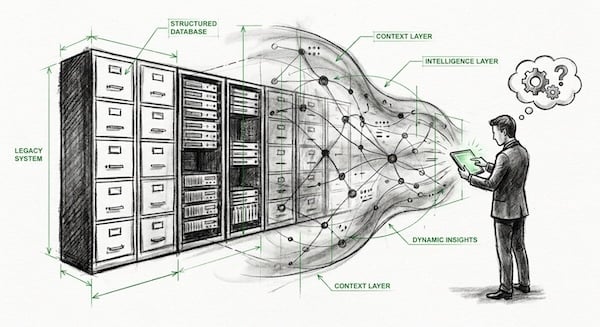
CRM is quietly going through the most fundamental change in its history, and almost nobody running a sales organization has clocked it. For thirty years CRM has been a structured database — a place reps go to log what they learned. That model is dying. CRM now captures everything itself, automatically, in the background. The unlock isn't a new feature. It's a complete shift in what CRM is for, who configures it, and how reps interact with it. Companies that understand this are about to build a commercial engine the laggards can't compete with. Most won't see it coming.
TL;DR
- CRM was built as a structured database - reps had to discern what mattered, navigate to a field, and type it in. Adoption split along a predictable line: top performers used it because it helped them manage complexity, average performers resented it as surveillance and never invested in it.
- That model is over. Recorded calls, emails, and meetings now feed CRM automatically. The data is there, or it isn't - and when it isn't, that's a signal about the rep's ability to elicit the right information, not a CRM configuration problem.
- CRM has shifted from structured to unstructured data. In a long-cycle, multi-stakeholder industrial sale, the volume of nuance is now far beyond what any rep can track manually - which is exactly the problem AI-first CRM and agents are built to solve.
- The mindset shift required is bigger than the technology shift and goes well beyond individual ACT and Goldmine transitioning to on-prem networked SalesLogix, to cloud based Salesforce or HubSpot. This shifts from entering data to unlocking it, from navigating a UI to having a conversation, and from needing a dedicated administrator to simply telling an agent what you want built.
- The biggest risk is treating this as a software upgrade rather than an operating model change. Buying a new platform and configuring it the old way - fields, forms, a certified administrator - is installing 2015 infrastructure at 2025 prices.
- Dropping some token/agent capability on top of a traditional CRM misses the shift.
The Seductive, Simple, and Wrong Way to Think About This
For most leadership teams, CRM has always been a compliance exercise. You buy the platform, you define the fields, you mandate that reps log their activity, and you build a dashboard so the VP of Sales can see who's behind on data entry. The assumption baked into that model is that CRM is fundamentally a discipline problem - get the reps to type more, and you'll have better data.
That assumption was always partially true and partially a trap. It's about to become entirely wrong.
CRM was designed as a database. You found something out, whether through research, a discovery call, a trade show conversation, and it was up to you to recognize it mattered, navigate to the right field, and type it in before you moved on to the next thing. The system never captured anything on its own. It captured exactly what a human decided to tell it.
Top performers used it anyway, and not because anyone made them. Good reps carry an enormous amount of complex information across a lot of live deals simultaneously, and CRM helped manage that load. They understood their memory was finite and their pipeline wasn't.
Average performers never bought in. They worried about big brother, decided the juice wasn't worth the squeeze, and put in just enough to keep their manager off their back. These are the same reps who don't bother to look at someone's LinkedIn before a discovery meeting .
CRM adoption was never really the problem. It was a symptom of a much bigger one: a lack of preparation and rigor that no amount of field redesign or gamification was ever going to fix. It was about mindset.
Where the Real Change Is Happening
The fix for low adoption was never going to be a better UI. What's actually changing the equation is that CRM no longer depends on the rep to capture the data in the first place. And therefore it's no longer dependent on their happy ears or selective listening. But, more than ever, it is dependent on their business acumen, consultative sales skills, and ability to build trust with prospects so they'll share material information.
From Structured Data Entry to Automatic Capture
CRM now ingests calls, emails, and meetings, including in-person ones, and surfaces what happened without anyone navigating to a field. The data is there, or it isn't. And when it isn't, that absence is no longer a CRM hygiene problem. It's a direct reflection of the rep's ability to elicit the right information and recognize what's important when they hear it. The job hasn't gotten easier. It's gotten harder, and more honest. A rep can no longer hide a weak discovery conversation behind a tidy CRM entry written after the fact.
From Structured Data to Unstructured Orchestration
Layer on the complexity of a real industrial sale - a six-to eighteen-month cycle, eight to twelve stakeholders across engineering, operations, and finance, competitive pressure shifting in real time. Tracking the facts was always hard. Tracking the nuance - who said what, what changed, what's no longer true - is harder still, and it's exactly the kind of unstructured, contextual information that structured CRM fields were never built to hold.
This is where AI-first CRM and agent orchestration completely change the function and capability. Not as a better notebook, but as a memory, reasoning and orchestration layer that can hold the entire unstructured picture of a complex deal, and surface what matters, when it matters, to the people who need it.
From Administrator-Gated to Conversational
The old model required a dedicated CRM administrator, or an outside consultant certified on the platform, to build anything meaningful - a new pipeline, an automation rule, a report, a new view, etc.. That gate is gone. Want a new pipeline for a new type of sale? Tell the agent. Want opportunities automatically created and staged the moment they hit certain criteria? Describe it. Want every inbound lead researched and a pre-meeting prep package built automatically before the rep picks up the phone? Tell the agent to build it and run it.
For PE-backed businesses, the most consequential version of this is governance: a pipeline review that rigorously examines every deal against your qualification scorecard and proactively flags managers and reps the moment a deal's qualification weakens or drifts out of criteria. That used to require months of consulting work and a dedicated administrator to maintain. It's now a conversation.
The Problem This Shift Can't Solve (And What To Do About It)
None of this works if the underlying sales organization is weak, and that's the trap a lot of companies are about to walk into.
I've watched teams building genuinely sophisticated AI-powered products - people who understand AI at a deep technical level - yet run their own internal CRM exactly like it's 2015. Debating which fields to require. Running pipeline reviews where the manager asks "what's the next step" and the rep reads off a line of text typed last week. Treating CRM like a filing cabinet and wondering why the data is thin or not even realizing that it is. Building with AI and operating your go-to-market function with AI sophistication are entirely different muscles, and a lot of companies, traditional industrial or cutting edge AI-First, haven't built the second one.
I had a long-time acquaintance tell me recently that they'd bought HubSpot and hired a consultant they'd worked with ten years ago to help set it up - just like they did a decade ago. I understand the appeal. After all, it's familiar, it's low cognitive load, you trust the relationship. But that decision borders on business negligence. It's installing 2015 infrastructure with 2025 pricing and calling it a CRM strategy, at exactly the moment the entire model is shifting underneath it.
This is fundamentally a mindset and leadership problem before it's a technology problem. AI-first CRM can't manufacture business acumen in a rep who doesn't have it. It can't make a weak sales leader rigorous. It can't retrofit accountability onto a culture that's never had it. For a PE sponsor on a five-to-seven-year hold, layering modern CRM on top of the wrong people and the wrong management discipline doesn't create alpha. However, it does make the existing weaknesses easier to see and harder to ignore.
The Question Leadership Should Actually Be Asking
The conversation in the boardroom shouldn't be "which CRM should we buy" or "should we upgrade to an AI-first platform." The right question is: are we ready to fundamentally rethink what CRM is for, who configures it, and how our team interacts with it, or are we about to buy new software and run it the old way?
I believe we're a year or two from a world where the CRM application itself is something most people never log into. The interface becomes wherever your team already lives - Slack, email, Teams (I feel for you), or whatever tool is the daily home base. The CRM becomes the orchestration layer behind it, not a destination anyone navigates to.
That's not a software upgrade. It's a complete rethinking of the function. The structured-data model - ask, log, refer back - is being replaced by an unstructured-data model where the system captures, remembers, and surfaces. The administrator model is being replaced by an agent model. The login-and-navigate model is being replaced by something ambient.
CRM is changing. The companies that get there first, with the right people and the right rigor underneath the technology, are going to build a commercial engine that the rest of the field can't match. Your move.
Frequently Asked Questions
How is CRM changing from a structured database to an AI-first system?
CRM was originally a structured database that required reps to manually log information into the right fields. AI-first CRM now captures calls, emails, and meetings automatically, shifting the rep's role from data entry to eliciting the right information and surfacing the nuance of complex, multi-stakeholder deals.
What does it mean that CRM is shifting from structured to unstructured data?
Structured data means information entered into predefined fields. Unstructured data means conversations, meeting notes, and call recordings. As industrial sales cycles grow more complex, with longer cycles and larger buying committees, CRM increasingly depends on managing, remembering, and incorporating unstructured data, which is where AI agents and orchestration layers add the most value.
Can AI-first CRM fix a weak or undisciplined sales organization?
No. AI-first CRM cannot manufacture business acumen in reps who lack it, cannot make a weak sales leader rigorous, and cannot retrofit accountability onto a culture that doesn't have it. It is an amplifier of the existing sales organization, not a substitute for the right people and process.
What should PE sponsors and portfolio company CEOs ask before adopting AI-first CRM?
Leadership should ask whether they are ready to fundamentally rethink what CRM is for and how the team interacts with it, rather than simply buying new software and configuring it the same way as the old, field-based system.
- Most complex industrial purchases must clear five separate buying decisions.
- Decisions 2 and 3 determine whether a purchase happens at all — and most reps don't know they exist.
- Most big-ticket B2B industrial forecasts are fantasies because they ignore those decisions.
- Buying teams typically include eight to twelve people.
- Reps need business acumen — not just product knowledge — to engage decision-makers early.