
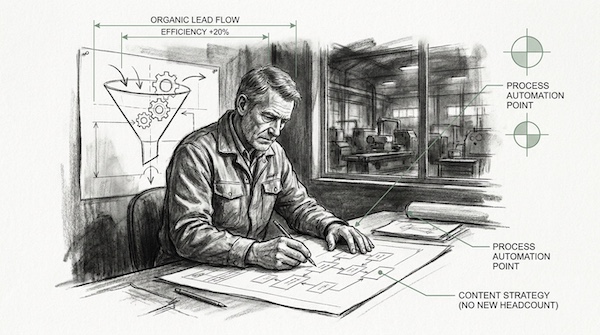
The most effective way for industrial companies to improve organic lead generation without adding marketing staff is to stop focusing on generating more leads for a sales team that can't use them. The real leverage comes from re-engineering the sales function itself, transforming it from a reactive order-taking unit into a proactive demand creation engine.
TL;DR
- The premise that industrial companies simply need "more leads" is often flawed. The core problem is typically a combination of lead waste, poor follow-up, unqualified leads, and a sales team structured to service existing accounts, not acquire new ones.
- Pouring more marketing-generated leads into a sales process where 40-60% of deals end in "no decision" is an inefficient use of capital. The bottleneck isn't the top of the funnel; it's the middle.
- The most powerful and cost-effective form of "lead generation" is prospecting that "creates projects" rather than just "finds projects." This means engaging potential buyers with a business-outcome-focused perspective long before they issue an RFP.
- This proactive approach requires a fundamentally different type of salesperson. Most industrial sales teams are hired for industry and product knowledge, which is useful for talking to engineers about existing projects. They often lack the business acumen to build a financial case with a CFO to create a new one.
- The most leveraged, non-headcount way to improve organic lead generation is to fix the sales hiring process to recruit, onboard, and manage reps who can create their own opportunities.
The Wrong Question Most Industrial Companies Ask About Lead Generation
When organic growth stalls, the first reaction in the forecast meeting is almost always the same: "We need more leads. Marketing needs to turn up the volume." And it is absolutely true that SEO, inbound marketing, form fills, keyword rankings, website visits, and visitor/lead conversion rates have all been falling precipitously for the past three years. Doing more of the same isn't the answer.
I see this in nearly every PE portfolio company and family-owned manufacturer I encounter. The assumption is that the revenue engine is sound, it just needs more fuel. The data says otherwise.
The reality inside these companies is that the engine is broken. Pouring more fuel on it won't create forward motion; it will just make a bigger mess. Consider the patterns we see over and over:
- Buyers have changed. Ten years ago someone would search, read a blog post, download a pdf, and accept a phone call from the most junior person on your team. Each of those is broken now. Buyers conduct their buying journey in private, and consume educational information passively through audio, video, and scrollable social content.
- Tactics must change. Video, video, video, podcast, community, PR, video, etc. Tactics must change to address buyers' expectations. For instance, not only is SEO content marketing of only specific, limited use now, your website itself is increasingly just a "bottom of funnel" asset.
- Nobody cares about what you make. Everything about your marketing and sales messaging must speak to the problems buyers have (known and unknown) and to the outcomes they can achieve by fixing them. Every syllable uttered about what you do simply commoditizes your products, company and people.
- Massive lead waste. Leads generated from significant investments like trade shows are notoriously under-worked. They get a single follow-up email, if that, before being abandoned. When companies talk about themselves they generate shoppers (often unqualified leads.) When they talk about buyer outcomes, they generate leads.
- A "no decision" epidemic. Data consistently shows that 40-60% of qualified pipeline opportunities in industrial B2B end in "no decision". The buyer simply decides to stick with the status quo or withdraw due to indecision. This isn't a lead volume problem; it's a sales effectiveness problem.
- An inability to win new logos. It's common for 70% or more of a company's revenue to come from repeat business with existing customers. This is celebrated as loyalty, but it's a glaring symptom of a sales team that is optimized for account maintenance, not new business acquisition.
Fixing your lead generation problem by hiring more marketers is likely to fail. You must adopt a customer mindset, adjust tactics, and ensure your sales team can close the leads you create (and generate their own!)
Secular Shifts: Why Your Old Lead Gen Playbook Is Broken
For decades, the industrial marketing and sales playbook was straightforward. You showed up at trade shows, you ran ads in trade publications, and you built a website that functioned as a digital catalog. Sales reps would follow up, talk specs with an engineer, and get into the bidding process.
Many leaders are still operating as if the decline in traditional lead generation is a cyclical change that will eventually revert to the old model. It won't. This is a secular, permanent change in how industrial buyers research and make decisions.
According to research from firms like 6sense, buyers are often 70% of the way through their decision-making process before they ever speak to a sales representative. They conduct their own research, build a short list, and often have a preferred vendor in mind before they ever fill out a form on your website.
When your sales rep gets a "lead" from marketing, they aren't getting in on the ground floor. They're often being invited to be the third quote in a process where the game is already tilted in a competitor's favor.
The Real Leverage: Shifting from "Finding Projects" to "Creating Projects"
This new buying reality demands a fundamental shift in strategy.
- Finding projects is the old model. It's reactive. Your reps are chasing RFPs, responding to inbound inquiries, and trying to get on short lists for projects that are already well-defined. They are playing a game they statistically cannot win.
- Creating projects is the new model. It's proactive. It involves engaging potential buyers at the executive level with a point of view on their business, not your product. It's about helping a COO see a production bottleneck they've normalized or showing a CFO how a capital investment can solve a labor availability problem.
When your team "creates a project," there is no RFP. There is no short list. You are the only one in the running because you architected the buying vision. This is, by far, the most capital-efficient and high-margin way to generate new business. It doesn't require a bigger marketing budget; it requires a better sales team.
And counterintuitively, it's the only way to differentiate your products. Talking about what you do and how you do it makes you sound like every other vendor.
Your Sales Team Is Your Lead Generation Engine (Or It Should Be)
Here is the uncomfortable truth: Most industrial sales teams are not equipped for this work.
Companies overwhelmingly hire for industry experience and existing relationships. They get reps who are comfortable talking about speeds and feeds with plant managers but who lack the business acumen to hold a credible conversation with a CFO. They know how to respond to a project, but they don't know how to create one.
This is a hiring and talent management, process, coaching and accountability failure. The disconnect is why we see the same pattern repeat in PE portfolio companies: a new sales leader is hired based on industry contacts, but that leader doesn't know how to build a team of project creators. The value creation plan stalls for 18-24 months, the leader is replaced, and the same flawed hiring criteria are used for their replacement.
It’s a systemic issue that a structured process like the Sales Talent Hiring & Recruiting service from Ed Marsh Consulting is designed to solve. It evaluates candidates on their ability to sell business outcomes and build demand, not just their product knowledge and network.
The Operational Discipline You're Missing
The most sophisticated manufacturers in the world apply immense rigor to their operations. They use Six Sigma. They model production lines. They would never tolerate a 40% defect rate on their factory floor.
Yet, they routinely accept that 40-60% of their sales reps will chronically miss quota.
Sales hiring and management are treated as a gut-feel art in a function that should be engineered with the same discipline as operations. PE-backed companies with brilliant finance teams will build complex financial models but often not model their sales funnel. They don't know what level of activity, at what conversion rate, is required to hit the revenue target. Without that model, how can you possibly define the profile of a successful sales hire? You can't.
This is about applying the same rigor to building your revenue team that you apply to your factory floor. Without a defined process for empirically comparing the contribution of marketing tactics to revenue, or identifying, evaluating, and hiring sales talent capable of creating demand, you're just rolling the dice every 18-24 months.
Improving organic lead generation without adding marketing headcount isn't a marketing problem. It's a leadership challenge to stop tolerating a broken sales hiring and management system and finally build the revenue engine your value creation plan depends on.
Frequently Asked Questions
Why do industrial companies face challenges with lead generation?
Industrial companies often face challenges with lead generation because they focus on increasing lead volume rather than improving the efficiency of the sales process. Marketing must change to meet new buyer habits and expectations. But before we worry about that we must fix more pressing problems. The main issues are lead waste, poor follow-up, and sales teams structured for maintaining existing accounts instead of acquiring new ones.
What is the problem with the traditional industrial sales model?
The traditional industrial sales model is problematic because it relies on reactive strategies, like chasing RFPs and responding to inbound inquiries, which are often tilted in favor of competitors. Industrial buyers are already well-informed before engaging with sales reps, making it difficult for traditional methods to be effective.
How can industrial companies create new organic leads effectively?
Industrial companies can create new organic leads effectively by transforming their sales teams to create projects instead of finding them. This involves engaging potential clients with business-focused discussions to identify problems and present solutions, thereby setting the buying vision and eliminating competition.
What role does the sales team play in improving lead generation?
The sales team should serve as the primary engine for lead generation. Improving lead generation involves restructuring hiring processes to recruit and manage salespeople who can generate their own opportunities and engage in business outcome selling, rather than just maintaining existing relationships. Once this is working, then it's time to improve the marketing function.