
The highest ROI comes not from specific AI tools, but from redesigning go-to-market roles, functions, activities, and processes around AI-enabled capabilities. It is a strategic overhaul of talent, management, and workflow, not a tactical technology purchase. Success requires a team capable of executing a modern, AI empowered playbook.
TL;DR
- Chasing AI tools is the wrong approach for most industrial companies. The real return on investment comes from fundamentally rethinking sales roles, workflows, and talent.
- The highest-value use cases are not in marketing automation but in GTM orchestration. Specifically, they focus on empowering all reps to outperform traditionally successful reps in creativity, coordination, analysis, preparation, and efficiency.
- AI can reveal the precise activities, skills, and conversations that lead to closed deals. However, this insight is useless if your sales team lacks the business acumen and process discipline to act on it.
- The biggest barrier to AI ROI is a sales organization built on ineffective hiring models, sales methodology, and process. Most industrial companies hire for industry experience, which perpetuates a focus on product-level conversations with technical buyers, not business-outcome conversations with executives.
- Before you invest in AI technology, you must fix the underlying human system. That starts with how you hire, manage, and hold your revenue team accountable. Once fixed, AI must be incorporated to perform functions that were traditionally too complex, time consuming or impractical.
An AI Exoskeleton
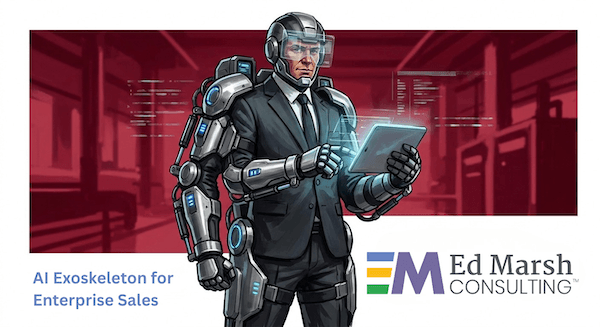 In his recent conversation on Shane Parrish's The Knowledge Project podcast, Opendoor CEO Kaz Nejatian described it perfectly. He described putting "an AI exoskeleton around every human being."
That's the best visualization I've heard (can you "hear" a "visual"ization?) and casts the way companies need to think about AI for GTM.
This isn't just about brute force. The military is investing in exoskeleton technology that does indeed allow troops to carry heavier, larger loads, further and faster. But that's not the real payoff. The outcome is that they arrive much fresher physically, and cognitively, for the mission once on target.
We should think of our GTM functions in a similar context - what would we have been doing if it had been possible? Not simply bludgeoning people with more inane AI generated cold prospecting emails, but rather ensuring that what's done is surgically precise and exquisitely efficient.
We need to right people, in completely reenvisioned roles. That takes courage, leadership, and willingness to make mistakes.
The Wrong Question Most Leaders Are Asking About AI
In boardrooms and ELT planning meetings, from PE-backed portfolio companies to family-owned manufacturers, many are asking "We're hearing about AI. Should we buy some tools for marketing and sales?"
It’s an understandable question. But it’s the wrong one.
It treats AI as a simple overlay, a piece of tech you can bolt onto your existing GTM motion to make it faster or more efficient. They probably wouldn't hang an Andon cord over the production line if they hadn't first investigated root causes and improved process. The technology is irrelevant because the underlying machine is fundamentally broken.
We see this same thinking gap constantly. A manufacturer that would apply Six Sigma discipline to wring a 1% efficiency gain out of a production line will tolerate a sales organization where >50% of the reps chronically miss quota and 40-60% of deals end in no decision. There is enormous rigor on the operational side of the house and almost none on the revenue side.
Asking which AI tool to buy is a tactical question that distracts from the real strategic imperative. The true value of AI is not in automating broken processes. It’s in empowering the complete reconsistition of how teams engage with buyers, and orchestrating a value-creating engagement for both parties.
Where the Real AI Leverage Exists: It’s Not Where You Think
Many initial forays into AI focus on top-of-funnel marketing activities like content generation or lead scoring. These can provide some incremental lift. But the real, transformative ROI for industrial companies lies deeper in the funnel, in the messy reality of sales execution.
Use Case 1: De-Risking the Pipeline and Improving Forecast Accuracy
For most PE sponsors and CEOs, the sales forecast is a work of fiction. It’s based on the gut feel of reps and the happy ears of managers. This is why 40 to 60% of deals in a typical industrial pipeline end in "no decision." They weren’t real opportunities to begin with.
AI offers a powerful antidote. AI can easily evaluate large volumes of deal history to build predictive opportunity scoring models. More importantly it can automate dynamic, continuous review of every conversation, meeting, email exchange and opportunity - to capture the subtle, correlated behaviors that signal a real, closable deal - and vice versa.
- Does the prospect engage with multiple stakeholders, including finance?
- Do they share internal documents?
- Have we identified their compelling reason to buy?
- Do we understand the complexities of capital allocation?
- What is the velocity of communication? (for instance incorporating JOLT Effect signals into qualification)
This data-driven qualification forces a level of rigor that is culturally alien to most sales teams. It exposes the costly difference between reps who are merely "finding projects" that are already in motion and those who are "creating projects" by engaging executives early to shape the buying vision. One fluffs the pipeline with low-probability pursuits; the other builds a forecast you can take to the board.
Use Case 2: Engineering the "Ideal" Sales Rep Profile and Activity
Even average PE firms have incredibly detailed financial models. Yet I've found that the most sophisticated almost never model their sales funnel. They can’t answer basic questions like:
- How many prospecting calls does it take to get one meeting?
- How many meetings lead to a qualified opportunity?
- What is our win rate on qualified opportunities?
- What is our average deal velocity?
Without these numbers, you can't define what "good" looks like. AI can change that. It can analyze the activity and communication patterns of your top 10% of reps and compare them to the rest of the team. It can codify what your best people do intuitively and turn it into a playbook.
This isn't about monitoring clicks and dials. It's about identifying the winning behaviors. Maybe your top reps consistently bring in an application engineer on the second call. Maybe they are 3x more likely to get a meeting with a CFO. AI quantifies these patterns, moving coaching from subjective opinion to objective fact. It gives your sales managers a blueprint for performance.
And once "figured out" it can orchestrate the activities and insights, leverage those in coaching agendas, and build infrastructure for reps. An exoskeleton.
The Systemic Failure That Makes Most AI Investments Worthless
The reality is many companies haven't succeeded (and few have tried). The AI models will generate a clear picture of what is required to win. They will tell you that success in complex industrial sales requires reps who can sell business outcomes, navigate executive politics, and build financial justifications.
But your sales team was not hired for those competencies.
Most industrial companies default to two hiring criteria: industry experience and a personal referral. You hire a rep from a competitor because they "know the industry" and "have a Rolodex." You hire a new VP of Sales because a board member knows them.
This practice perpetuates the very problem AI is supposed to solve. You hire people who are comfortable talking about speeds and feeds with plant engineers because that’s what they’ve always done. They lack the business acumen to have a credible conversation about outcomes and business impact with a CFO. They are order takers in a world that now requires business consultants.
All the creatively applied AI in the world will only reveal that gap.
You are trying to run new software on old hardware. The AI experiments will fail because the people and the system they operate within are mismatched with the demands of the modern buyer.
The Prerequisite for AI Success: Fixing Your Talent Engine
Before you spend a dollar on some GTM AI, you have to ask a more fundamental question: Do we have a team capable of executing a modern, data-driven sales process?
If your answer is no, technology is not the solution. If the answer is that you're not sure, that's an answer too.
The problem is your talent acquisition and management engine. The pattern is predictable, particularly in PE portfolio companies. A new sales leader is hired based on their resume, they fail to build the necessary process and accountability, and 18 to 24 months later they are replaced by another person hired using the same flawed, gut-feel criteria. This cycle can burn through half of a five-year hold period.
This is where you must get ruthlessly objective about how you identify, evaluate, and hire sales talent. It's why a structured approach like a Sales Talent Hiring & Recruiting engagement is so critical. A proper system stops the cycle of hiring for yesterday's sales environment and starts building a team that can execute in a modern go-to-market model. The right process evaluates candidates for the specific competencies needed to succeed today, not just for the logos on their resume. I've seen it repeatedly, without fixing the hiring process, your AI investment (or any investment in marketing or sales) is just an expensive way to prove your current team can't sell.
The Real ROI is a Leadership Decision, Not a Tech Purchase
The highest-ROI "use case" for AI in an industrial company isn't a use case at all. It is a leadership commitment to finally re-engineer the sales function with the same discipline and data-driven rigor that has been applied to operations for decades.
It means accepting that how you've always hired sales talent is no longer working. It means building a system to identify reps and leaders who possess true business acumen, not just product knowledge. It means building a management culture grounded in coaching and accountability.
AI can provide the map to higher performance, but you need drivers who can actually navigate the terrain. For most industrial companies, that means it’s time to topgrade the sales talent and process. Before we worry about the ROI of AI we should embrace high-stakes questions it forces leaders to finally ask about their people and their processes.
Frequently Asked Questions
What is the real source of ROI for AI in industrial companies?
The real source of ROI from AI for industrial companies comes not from specific tools, but from redesigning sales roles, workflows, and talent around AI-driven insights. It involves a strategic overhaul of the sales process rather than a simple technology purchase.
Why is focusing on AI tools a misguided approach?
Focusing solely on AI tools is misguided because it treats AI as a plug-in solution rather than addressing fundamental issues in the GTM motion, talent, sales process, etc.. Without fixing the underlying human system and how sales teams are hired, managed, or held accountable, technology investments may fail to deliver their potential ROI.
How can AI improve sales processes in industrial companies?
AI can enhance sales processes by de-risking the pipeline, improving forecast accuracy, and profiling successful sales activities. It achieves this by analyzing historical deal data to develop predictive models and identify the behaviors that lead to successful deals, thereby providing a data-driven approach to sales execution.
What changes are necessary before investing in AI technology?
Before investing in AI technology, it's critical to evaluate and improve the sales talent engine. This involves implementing a rigorous hiring process focusing on business acumen rather than industry experience, and establishing a management culture based on accountability and coaching.

