
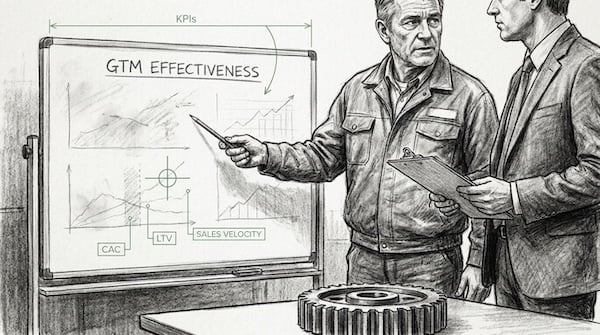
Focus on a balanced scorecard of leading and lagging indicators. Start with new logo first meetings and qualified opportunities entering the pipeline. Then track Pipeline Coverage, Win Rate (by new logo vs. existing) with a clearly defined and consistently maintained denominator definition, Sales Cycle Velocity, and CAC Payback. These reveal the health of your revenue engine far better than top-line revenue and gross pipeline value alone. The marketing side is more complex as we've learned the folly of vanity metrics like website visits in a world of evolving and opaque buyer behaviors.
TL;DR
- Traditional KPIs like total revenue, website visits, keyword rankings, and gross pipeline value are lagging indicators that hide serious go-to-market problems in industrial companies. They tell you what happened, not what's about to happen, much less how to forestall a decline and engineer improvement.
- A better scorecard focuses on leading indicators: Have you engineered your funnel? What is required as activity and input at each stage (against clear definitions) to drive the results? What are the key conversion rates through the funnel (think of it like efficiency in steps in your manufacturing - that's the analogy behind ORE™ that looks at revenue using an OEE approach.) Is your pipeline coverage sufficient to hit the plan? How fast are deals moving? Are reps creating new projects or just chasing RFPs?
- Key lagging indicators must be segmented. What is your win rate on new logo business? What percentage of revenue is from new customers? What % of revenue is from projects your sales team created vs. inquiries? This exposes an over-reliance on the installed base.
- Ultimately, the KPIs reveal the quality of your Go To Market leadership (marketing, sales and success) and process. Chronic underperformance on these metrics is often a symptom of a systemic hiring and management problem, not just a rep or tactic problem.
The Bridge Slide That Confuses Reality
What happens when PE portfolio company board reviews revenue results? Often they're compared against previous periods and the original thesis. And organic revenue growth often falls short. But then there's a pipeline chart that looks reassuringly large. Everyone nods. Finally, they think, breathing a sigh of relief. There are some questions around why it's actually going to work this time, maybe an admonition about needing to see results. And then the meeting moves on.
This is a failure of governance.
Gross revenue and total pipeline value are two of the most misleading metrics in industrial B2B. They are lagging indicators that tell you where you’ve been, not where you are going. A pipeline full of unqualified, slow-moving deals looks the same on a bar chart as a pipeline of high-probability, well-managed opportunities. For a PE sponsor operating on a five-to-seven year hold period, discovering the difference two years in is a value creation disaster - because truly fixing this will take at least a couple years, and by then the end of the runway is coming up too fast.
The conventional metrics obscure the truth. We need a scorecard that reveals the health of the revenue engine, not just its output.
A Better Scorecard: Separating Leading from Lagging
A manufacturer that would never tolerate a 40% defect rate on the production floor somehow accepts that most leads never are contacted more than twice, that only a tiny fraction of inbound leads ever convert to orders, that forecasts are chronically inaccurate (and ALWAYS excessively optimistic) and that 40 to 60% of its sales reps chronically miss quota. This happens because most industrial companies manage operations with rigorous process discipline but manage sales with gut feel and superstition.
Building a predictable revenue engine means instrumenting it correctly from input (demand creation) through output (lifetime value realization with solid margins.) That requires a balanced set of metrics, just like you’d have on a factory floor. We need leading indicators that function as an early warning system and lagging indicators that tell the true story of our results.
Leading Indicators: Your Early Warning System
These metrics predict future revenue. If they are trending negative, you have time to intervene before you miss the quarter.
- Demand Creation: Trade shows are important, and you need a website - but are those the real answer to the demand creation and brand/problem awareness that's really necessary in a ZERO Trust and Zero CLICK world? Short answer, no. Particularly when lead follow up is almost universally poor and the metrics on buying journeys show that the liklihood of winning on inquiries is relatively low.
- Pipeline Coverage: This isn’t just your total pipeline value. It’s the value of qualified pipeline needed to hit your revenue target, factored by your historical win rate. If your target is $1M and your win rate is 25%, you need $4M in qualified pipeline. Anything less, and you are mathematically set up to fail.
- Sales Cycle Velocity: How long does it take for a deal to move from an initial discovery call to Closed-Won? If this number is increasing, it’s a massive red flag. It often means deals are stalling out and heading toward "no decision," which is the outcome for 40 to 60% of B2B deals.
- Opportunity Qualification Score: This forces discipline. Instead of just adding a deal to the CRM, reps must score it quantitatively and qualitatively against defined criteria (budget, authority, need, timeline, etc.). This metric instantly separates a real pipeline from a bloated wish list and provides a basis for meaningful pipeline reviews.
- Meaningful Activity Metrics: Stop tracking dials and emails. Start tracking activities that actually correlate with success. For complex industrial sales, this could be the number of initial discovery calls with executive buyers, not insantiy like the number of proposals submitted (the results of which Goodhart's Law clearly predicts.) The goal is to measure activities that "create projects," not just "find projects" that are already 70% of the way to a decision before you get involved.
- Lifetime Value Creation and Growth: The first order is always the hardest...and the most expensive. How effective, deliberate and efficient are you at turning those first orders into years of repeat and expanding orders?
Lagging Indicators: The Real Story of Your Results
These metrics measure past performance, but when segmented correctly, they provide a powerful diagnosis of what’s broken.
- Win Rate (Segmented): A blended win rate is useless. You must separate the win rate for new logo acquisition from the win rate on proposals to existing customers. The latter is always higher and masks the anemic new business performance common in industrial companies where 70% of revenue comes from repeat business.
- New Logo Revenue %: For a PE-backed company with a value creation plan dependent on new business, this number is paramount. If it’s below 30% of total revenue, your team is structured for farming, not hunting.
- Customer Acquisition Cost (CAC) Payback Period: How many months of gross margin does it take to recoup the fully-loaded cost of acquiring a new customer? In a capital-constrained environment, a long payback period can cripple growth. This is a metric the CFO and the board must understand intimately - in industrial, not just SaaS where it's commonly discussed.
- Revenue per Rep: Simple, brutal, and effective. When you see that a significant portion of your team is not covering their own costs, it forces a conversation. Is it a coaching problem? A territory problem? Or did we hire the wrong people to begin with?
Your KPIs Are a Symptom, Not the Disease
Here is the uncomfortable truth: if these KPIs look bad, you don’t have a measurement problem. You have a people, process, and leadership problem.
Collapsing keyword rankings, website traffic and inbound leads are a fact and reflection of market and buyer changes, not something to resolve by doubling down on what worked in 2015.
A low new-logo win rate isn’t a sales failure; it's a symptom of a GTM strategy that hires reps for "industry experience," which typically means they have great product knowledge but no business acumen to hold a conversation with the C-suite. It also reflects a process built on prospecting for active projects rather than developing business acumen and understanding buyers' businesses with adequate depth to create them.
A long sales cycle isn’t a market condition; it’s a symptom of having no formal sales process, poorly defined opportunity qualification criteria, and weak sales management that provides no coaching.
These are systemic failures. And they almost always trace back to board familiarity with GTM, mindset, hiring and process. Most industrial companies hire sales leaders and reps based on referrals and industry contacts, a cycle that perpetuates mediocrity. You get what you’ve always gotten. For PE sponsors, this flawed approach can burn 18-24 months of a hold period with a failed sales leadership hire.
Breaking this cycle requires a fundamentally different approach, one that treats hiring as an engineering discipline, not a gut-feel exercise. That’s why a structured Sales Talent Hiring & Recruiting process is the prerequisite for improving any other GTM metric. No KPI dashboard in the world can fix a team that was hired using the wrong criteria and is managed without process or accountability.
The Board's Role in Demanding Better Metrics
Governance is about asking the right questions. For PE sponsors and board members overseeing an industrial portfolio company, the responsibility is to push past the vanity metrics on the bridge slide.
Stop asking, "What’s the total pipeline?" Start asking:
- "How are we adapting demand creation - please show specific results."
- "How is AI helping us improve attribution to measure the actual return on spend for specific marketing activities?"
- "Show me the pipeline coverage for new logo acquisition specifically."
- "What was our win rate on deals where we were not on the initial short list?"
- "How has our average deal size for new customers changed in the last 12 months?"
- "What growth are we showing in reorders and lifetime value?"
These questions force a more rigorous conversation. They expose the soft spots in the GTM strategy and hold revenue leadership accountable for building a system, not just hitting a number. They separate the leaders who can architect a revenue engine from the managers who can only administer the status quo.
The challenge is that most industrial and manufacturing company boards lack independent (or executive) directors with contemporary GTM experience. While the board is not there to operate the GTM function, effective oversight - the ability to know the right questions to ask and how to interrogate and vet the responses - requires that savvy. It's often lacking, particularly compared to finance and operations which are therefore understandably better governed and executed.
Your go-to-market metrics aren't just numbers on a slide; they are the definitive signal of your leadership's ability to build a predictable revenue engine. Start measuring what actually matters, and you'll be forced to confront the systemic changes you truly need to make.
Frequently Asked Questions
What KPIs are vital for assessing GTM effectiveness in industrial companies?
A balanced scorecard of Pipeline Coverage, Win Rate, Sales Cycle Velocity, CAC Payback, and a mix of leading and lagging indicators are essential to measure the GTM effectiveness in industrial companies.
Why are traditional KPIs like total revenue and gross pipeline value insufficient?
Traditional KPIs are lagging indicators and don't provide insights into future performance, hiding potential go-to-market problems by showing where you’ve been, not where you are going.
How do leading indicators function as early warning systems?
Leading indicators like Pipeline Coverage and Sales Cycle Velocity can predict future revenue downtrends, allowing intervention before missing targets. They provide early warnings of declining pipeline health.
What role should the board play in evaluating GTM metrics?
The board should focus on asking probing questions about specific metrics like new logo pipeline coverage and win rates, pushing past vanity metrics to demand accountability and systemic improvements.
- Most complex industrial purchases must clear five separate buying decisions.
- Decisions 2 and 3 determine whether a purchase happens at all — and most reps don't know they exist.
- Most big-ticket B2B industrial forecasts are fantasies because they ignore those decisions.
- Buying teams typically include eight to twelve people.
- Reps need business acumen — not just product knowledge — to engage decision-makers early.