
What's a reasonable marketing budget?
B2B manufacturers are traditionally rather parsimonious in their marketing spend. So while Coke spent $2.9B (8.3% of $35B of revenue in '10 - from BusinessInsider) on marketing, that's irrelevant to a typical industrial manufacturing company. Similarly the fact that Salesforce.com spent $25.4M to create $5.4M in it's first revenue positive year (from Marketo) is meaningless.Business models which require substantial investment in long-term assets to support manufacturing, and sizable current assets in the form of raw materials and inventory are quite different than knowledge based business models. So intuitively it's reasonable that budgets would be constructed differently.
And with nary an exception, in the industrial world of B2B marketing, the marketing budget is considered the first point of spending reduction flexibility in any budgeting cycle. Per IndustryWeek, "marketing budgets are the most unloved of all budgets at most industrial companies."
Sales vs. Marketing or Sales & Marketing
One distinction to consider is spending on direct sales vs. spending on marketing. Traditionally, industrial companies have invested heavily in direct sales while marketing has occupied a lessor role - in perception and budget heft.Research on recent changes in buying habits provides important insight into this allocation. Where marketing used to support the first 10% of the sales process, with direct sales taking over thereafter, today buyers have learned to leverage digital tools and widely available information to self-service themselves through 70% of their buying process. That reduces the burden on direct sales and substantially increases the marketing burden - not only in volume of work, but in scope and responsibilities as well.
Absolute vs. relative budgeting
If a manufacturing company is growing sales faster than they can grow production, clearly their marketing budget is more than adequate - even if it's zero. But precious few B2B industrial companies find themselves in that position. Rather the question becomes "What must we spend to drive the results we require?"That's a notoriously difficult question to answer with traditional B2B marketing. Techniques often offered no clear ROI and the impact of marketing activities was often difficult to associate with specific results.
That's changed. Now with properly planned digital marketing, B2B manufacturers in industrial markets can establish empirical goals for profit and revenue, and based on typical metrics, extrapolate what number of leads must be harvested and what activities will be required to drive those leads. It's even possible to predict how different intensity and pace of marketing will translate to different rates of business development success.
Therefore it's not necessarily helpful to establish a marketing budget as a percent of revenue or some other arbitrary measure.
But there's value in benchmarking
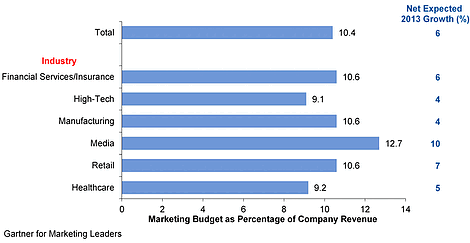 Nevertheless, since manufacturing companies have typically under spent, many are startled at the magnitude of investment that would be required to drive their desired results.
It's instructive to look at guidelines and recommendations from various resources:
- Gartner's research on marketing budgets for '12 found that on average manufacturing companies spent 10.6% of revenue on marketing.
- Inc's article on budgeting for '14 marketing notes that according to IDC the weighted marketing spend (as % of revenue) is 6.4%.
- Some marketing agencies angling for bigger contracts will suggest that B2B companies should spend up to 15%
- The SBA suggests that companies with less than $5M in revenue should normally spend 7-8%
That will create consternation for some and relief for others. It's not a hard and fast number, but it's a "ballpark" planning guideline.
Any marketing spend should be against a detailed plan for execution with a clear ROI. Simply making a small adjustment to last year's number, or arbitrarily applying a percentage would be silly. But understanding what's generally considered appropriate will provide a solid basis for beginning your B2B marketing planning.
Want to understand how digital marketing could boost your B2B sales? Check out our free guide.

image / data source - Gartner.com

Ed Marsh
Ed was going to be an architect because he loved the nexus of engineering and design. That was before was going to be an engineer; before he graduated from Johns Hopkins; before he was an Army Infantry Officer (Airborne Ranger); before he set B2B industrial sales records; before he was partners with a German capital equipment manufacturer; before he founded a distribution/rep company for industrial products in India; until he decided that managing a business and employees wasn’t what he enjoyed. Now that Ed’s got all of that out of his system he runs a consultancy that helps US manufacturing companies grow by applying process excellence to business development – completing the full circle back to an engineering & design combination. His practice is built on a unique methodology which combines powerful digital marketing methodologies (a HubSpot partner) with his extensive international biz dev experience.